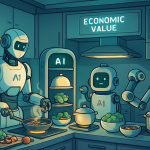

Okay, folks, buckle up. We’re diving deep into some serious AI numbers that just dropped hotter than a fresh neural network. Cathy Li, the AI, Data, and Metaverse guru over at the World Economic Forum, just announced that global investment in artificial intelligence has rocketed to nearly $600 billion since 2010. Let that sink in. Six. Hundred. Billion. That’s enough to buy Wakanda, build a real-life Millennium Falcon, and still have enough left over for a lifetime supply of avocado toast.
Li, speaking ahead of the Davos 2026 summit (where, presumably, the global elite will be debating whether AI will automate their jobs or just write better speeches for them), called this surge the fastest large-scale capital reallocation in modern history. Forget the dot-com boom, forget the crypto craze, this is AI taking the financial world by storm. It’s like Skynet decided to invest in itself, only, hopefully, without the whole “Judgment Day” thing.
Now, before you start picturing robot overlords cashing dividend checks, let’s unpack what this actually means. We’re talking about massive investments in everything from AI-powered drug discovery to self-driving cars to, yes, even those slightly creepy AI-generated art platforms that are flooding your social media feeds. This isn’t just about Silicon Valley startups anymore; it’s about established giants and governments alike pouring resources into the AI gold rush.
And who’s leading the charge? According to Li, the United States and China account for approximately 65% of this total investment. That’s a whole lot of AI innovation happening on two continents, and it underscores the growing tech rivalry between these two superpowers. It’s a technological arms race, but instead of missiles, they’re building algorithms. Think “Cold War,” but with more GPUs and less espionage (maybe).
But why now? What sparked this sudden AI frenzy? To understand that, we need to rewind a bit.
The Genesis of the AI Boom
The seeds of this AI revolution were sown decades ago, with theoretical breakthroughs in neural networks and machine learning. However, it wasn’t until the confluence of several key factors that things really took off. First, we had the explosion of data. The internet, social media, and the Internet of Things (IoT) have created a tidal wave of information, providing AI algorithms with the fuel they need to learn and improve. Second, advances in computing power, particularly the rise of GPUs, have made it possible to train these complex models in a reasonable amount of time. Remember those old dial-up modems? Try training a large language model on *that*.
And finally, there’s been a shift in mindset. AI is no longer seen as a futuristic fantasy; it’s a practical tool with the potential to solve real-world problems and generate massive profits. Companies are realizing that they need to embrace AI or risk being left behind in the digital dust. It’s the “innovate or die” mantra, but with a silicon twist.
The Ripple Effects: Who Wins, Who Loses?
So, who benefits from this $600 billion bonanza? Well, clearly the AI companies themselves are doing pretty well. Think of the Googles, Amazons, and Microsofts of the world, all of whom are heavily invested in AI research and development. But the impact extends far beyond the tech giants. Industries like healthcare, finance, and manufacturing are all being transformed by AI, leading to increased efficiency, improved products, and new business models.
But there’s a flip side to this coin. The rapid adoption of AI is raising serious concerns about job displacement. As AI-powered robots and algorithms become more capable, they’re increasingly able to perform tasks that were previously done by humans. This could lead to widespread unemployment in certain sectors, particularly those involving repetitive or manual labor. It’s the age-old fear of machines taking our jobs, but this time, it’s powered by deep learning and big data.
And that brings us to the ethical considerations. As AI becomes more powerful and autonomous, we need to grapple with questions about bias, accountability, and control. Who’s responsible when an AI makes a mistake? How do we ensure that AI algorithms are fair and unbiased? And how do we prevent AI from being used for malicious purposes? These are not just abstract philosophical questions; they’re pressing issues that need to be addressed as AI continues to evolve.
The Political and Societal Chessboard
The rise of AI is also reshaping the geopolitical landscape. As the United States and China vie for AI supremacy, other countries are scrambling to catch up. Governments around the world are investing heavily in AI research, developing national AI strategies, and enacting regulations to govern the use of AI. It’s a complex and rapidly evolving situation, with the potential to reshape the global balance of power. Think of it as a high-stakes game of digital chess, where the winner gets to define the future of technology.
And let’s not forget the societal implications. AI has the potential to transform almost every aspect of our lives, from how we work and communicate to how we learn and interact with the world. It could lead to new forms of creativity, new ways of solving problems, and new opportunities for human connection. But it could also exacerbate existing inequalities, create new forms of surveillance, and erode our privacy. It’s up to us to ensure that AI is used in a way that benefits all of humanity, not just a select few.
The Bottom Line: AI is Here to Stay
So, what’s the takeaway from all this? The $600 billion investment milestone is a clear indication that AI is not just a passing fad; it’s a fundamental shift in the technological landscape. It’s a force that will continue to shape our world for decades to come. Whether that future is a utopian paradise or a dystopian nightmare depends on the choices we make today. We need to invest in education, develop ethical guidelines, and foster international cooperation to ensure that AI is used for good. The future is not predetermined; it’s up to us to write the code.
Discover more from Just Buzz
Subscribe to get the latest posts sent to your email.