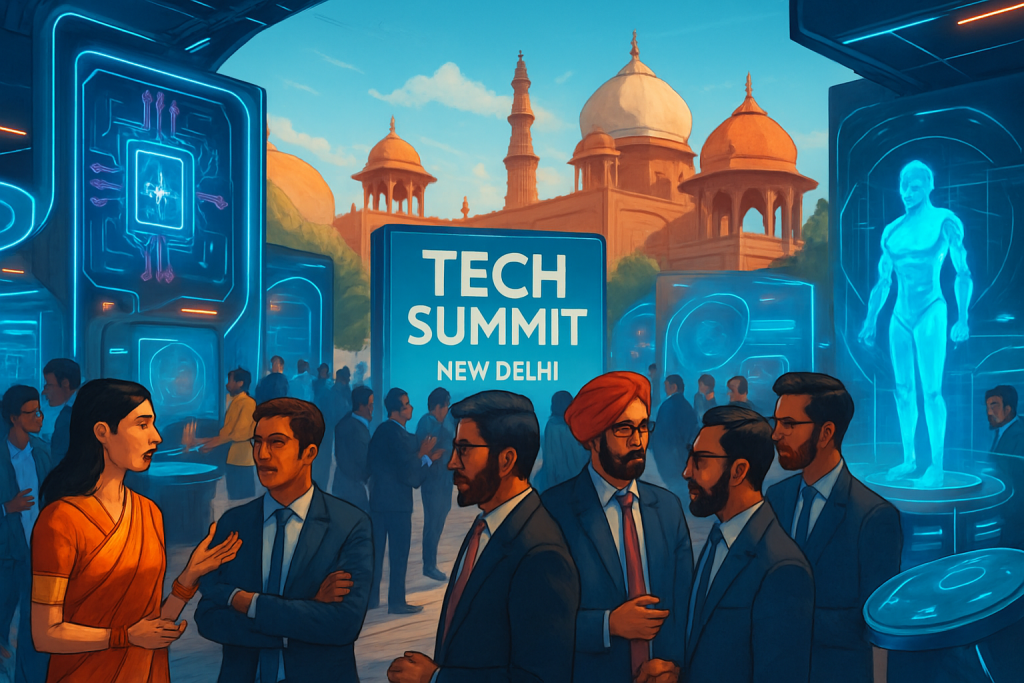

The air in New Delhi crackled with anticipation. Not just from the usual hustle and bustle of the city, but from something far more electric: the inaugural AI Impact Summit. Imagine Tony Stark touching down in a developing nation, not to sell weapons, but to share the secrets of Jarvis. That’s the vibe. From February 16th to 20th, 2026, the Bharat Mandapam convention center transformed into the epicenter of a global conversation, one where the future wasn’t just being predicted, it was being actively shaped.
This wasn’t just another tech conference. This was India’s coming-out party on the AI stage, a bold declaration that the future of artificial intelligence wouldn’t be solely dictated by Silicon Valley, or even Beijing. Forget the tired tropes of futuristic dystopias; this summit was about “welfare for all, happiness for all,” as Prime Minister Modi so eloquently put it. Think less Skynet, more universal basic income powered by smart algorithms.
But how did we get here? The AI Impact Summit didn’t materialize out of thin air. It’s the latest stop on a well-worn, increasingly urgent, global conference circuit. First, there was the AI Safety Summit at Bletchley Park in 2023, a sober gathering focused on the potential existential threats posed by unchecked AI development. Then came the AI Seoul Summit in 2024, which started to nudge the conversation towards governance and ethical considerations. And last year, Paris hosted the AI Action Summit, pushing for concrete, measurable outcomes. New Delhi is the culmination of all these events, a place where theory meets real-world application, especially for the developing world.
The guest list read like a who’s who of the tech world and beyond. Alphabet’s Sundar Pichai, OpenAI’s Sam Altman (fresh off his latest world tour, no doubt), Anthropic’s Dario Amodei, and even Reliance’s Mukesh Ambani were all in attendance. And adding a dash of geopolitical gravitas, French President Emmanuel Macron graced the event with his presence. It’s a testament to the fact that AI isn’t just a tech issue anymore; it’s a matter of national strategy and global power.
What made this summit different? It wasn’t just about pontificating on the wonders (or dangers) of AI. It was about doing. India’s approach, as articulated throughout the summit, centers on “application-led innovation.” Instead of trying to compete with the US or China in building massive, foundational AI models from scratch, India is focusing on integrating AI into existing sectors like agriculture, healthcare, education, and public services. Imagine AI-powered crop management systems boosting yields for small farmers, or AI-driven diagnostic tools bringing quality healthcare to remote villages. This is the vision.
Of course, no revolution comes without its challenges. India’s rapid adoption of AI is a double-edged sword. On one hand, the country has embraced generative AI with open arms. By late 2025, India had become the largest user market for ChatGPT, boasting a staggering 72 million daily users. That’s a lot of people asking AI to write their poems, debug their code, or just have a conversation. On the other hand, India’s massive $283 billion IT services sector, the backbone of its economy for decades, faces a potential existential threat.
Analysts are already warning that automation and AI-driven efficiencies could decimate call centers and back-office operations, potentially displacing millions of workers. It’s the classic “robots taking our jobs” scenario, but on a scale that could have profound social and economic consequences. The summit addressed these concerns head-on, with discussions focusing on retraining programs, workforce adaptation strategies, and the need for a social safety net to cushion the blow.
The AI Impact Summit also raised some deeper, more philosophical questions. How do we ensure that AI benefits everyone, not just the privileged few? How do we prevent AI from exacerbating existing inequalities, both within and between nations? And perhaps most importantly, how do we maintain human control over AI, ensuring that it remains a tool for good, rather than a force that shapes our lives in ways we don’t understand or approve of?
These are not easy questions, and there are no easy answers. But the fact that they were being asked, and debated, at a summit hosted by a developing nation signals a significant shift in the global AI discourse. India is not just a consumer of AI; it’s a potential leader, a voice for the billions of people who stand to benefit most from this technology, but who also face the greatest risks if it’s not developed and deployed responsibly. The world is watching, and the future of AI may well be written in New Delhi.
Discover more from Just Buzz
Subscribe to get the latest posts sent to your email.