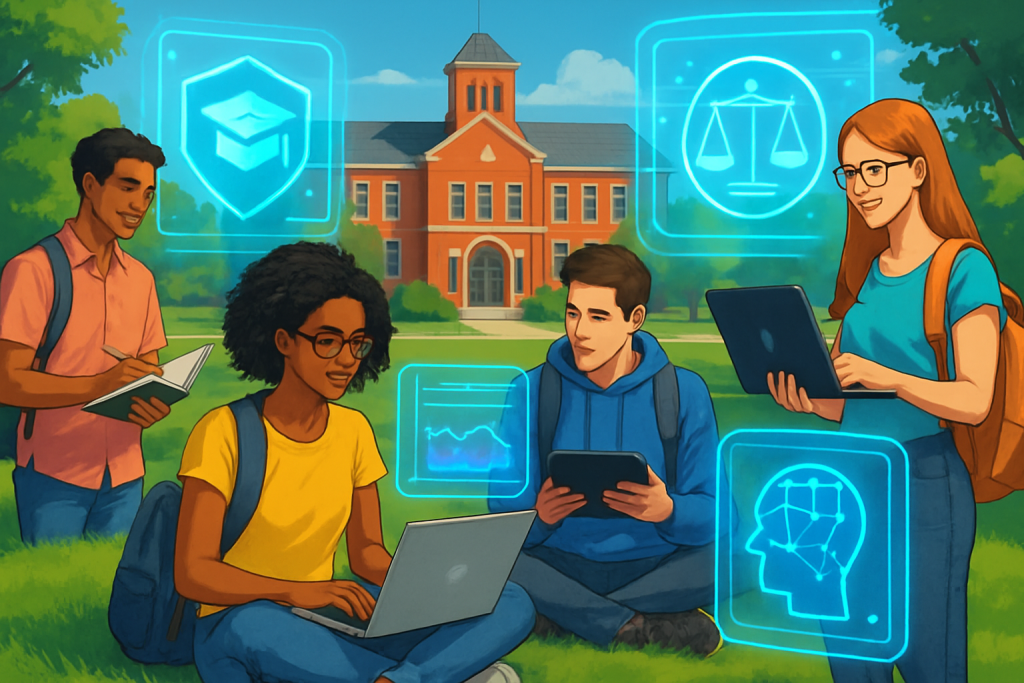

The robots aren’t just coming; they’re already enrolled. At least, that’s the vibe we’re getting after the California State University (CSU) system dropped the findings from its monumental AI survey on April 1st, 2026. No, this wasn’t an elaborate April Fool’s joke; it’s a serious deep dive into how AI is reshaping the landscape of higher education.
Think of the CSU system as the educational equivalent of a sprawling metropolis. With 23 campuses and over 480,000 students, it’s the largest public university system in the US. So, when CSU speaks about anything, especially something as disruptive as AI, the world listens. This survey, pulling in over 94,000 responses from faculty, staff, and students, is basically the “Citizen Kane” of AI in academia right now. It’s massive, comprehensive, and probably going to be dissected for years to come.
The burning question: Is AI the academic savior we’ve been waiting for, or a digital Pandora’s Box? The answer, unsurprisingly, is a bit of both. The survey paints a picture of widespread AI adoption. We’re not talking about just the CS majors huddled in labs, either. Students are using AI tools for everything from research to writing (plagiarism detectors, brace yourselves!), while faculty and staff are exploring its potential to streamline administrative tasks and personalize learning experiences. Imagine AI-powered tutors that adapt to each student’s learning style, or algorithms that can predict which students might need extra support before they fall behind. It sounds like something straight out of “Star Trek,” but it’s becoming increasingly real.
The perceived benefits are tantalizing. Personalized learning, efficient admin, data-driven decisions: it’s the holy trinity of modern education. Suddenly, those endless hours grading papers could be spent on more engaging activities, like, you know, actually teaching. But, and this is a big but, the survey also revealed a significant undercurrent of concern.
Data privacy is a huge one. With AI systems gobbling up vast amounts of student data, the potential for misuse or breaches is a very real fear. Remember when Facebook had to answer for its data practices? Multiply that by the sensitive information held by a university system, and you get a sense of the stakes. Ethical implications are another major worry. Are we creating a generation of students overly reliant on AI, stifling their critical thinking skills? Are we inadvertently baking biases into algorithms that could perpetuate inequalities? These are not just academic hypotheticals; they are real-world problems that need addressing.
And then there’s the question of AI literacy. It’s not enough to just hand out AI tools and hope for the best. Faculty and students need to understand how these tools work, their limitations, and their potential biases. It’s like giving someone a lightsaber without teaching them how to use the Force; things are bound to go wrong.
The survey makes one thing abundantly clear: the CSU community is clamoring for institutional support. They want professional development to up their AI game, clear guidelines on how to use AI responsibly, and investments in the necessary infrastructure. It’s a call for leadership, a plea for the university to step up and guide them through this AI revolution.
What does all this mean for the future of higher education? Well, the CSU’s survey is likely to be a watershed moment. Other universities will be watching closely, learning from CSU’s successes and failures. The findings are expected to inform policy decisions, curriculum development, and resource allocation not just within the CSU system, but potentially across the nation. We might see new courses on AI ethics, new regulations on data privacy, and a renewed focus on critical thinking skills. The implications go beyond the classroom, too. If AI can revolutionize education, what other sectors are ripe for disruption?
The financial and economic implications are also worth considering. Companies developing AI-powered educational tools stand to gain big time. But, universities will need to invest heavily in AI infrastructure and training. And what about the job market? Will AI create new jobs in education, or will it displace existing ones? These are questions that policymakers, educators, and students alike need to grapple with.
Ultimately, the CSU’s survey is a wake-up call. AI is here to stay, and it’s transforming higher education in profound ways. We need to embrace its potential, while also addressing its challenges head-on. We need to ensure that AI is used ethically, responsibly, and in a way that benefits all students. The future of education may very well depend on it.
Discover more from Just Buzz
Subscribe to get the latest posts sent to your email.