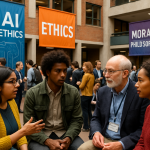
Alright, tech enthusiasts, buckle up. Because while your neighbor’s smart fridge is busy ordering more oat milk, something far more profound is brewing in the hallowed halls of academia. Yesterday, April 7th, 2026, the University of Scranton dropped a bombshell, announcing a national interdisciplinary conference titled “Confronting the Ethics of Artificial Intelligence,” slated for April 16th to 18th. Before you roll your eyes and mutter something about ivory towers, let me tell you why this seemingly niche event is actually a five-alarm fire signal for the future of, well, everything.
Think about it. AI isn’t some sci-fi fantasy anymore. It’s woven into the fabric of our lives, from the algorithms that curate our social media feeds (and, let’s be honest, often our echo chambers) to the increasingly sophisticated AI powering self-driving cars, which, by the way, are still occasionally mistaking squirrels for speed bumps. And as AI gets smarter, more powerful, and more deeply embedded, the ethical questions surrounding its use become exponentially more complex.


This isn’t just about whether Skynet is going to become self-aware and launch a nuclear holocaust. Although, let’s be real, that’s always a low-level hum in the back of our minds, isn’t it? It’s about far more subtle, insidious challenges. Algorithmic bias in loan applications. AI-driven surveillance eroding privacy. The displacement of human workers by increasingly capable robots. The potential for AI to be weaponized in ways we haven’t even begun to imagine. It’s a minefield, folks, and Scranton is trying to defuse it, one academic paper at a time.


The conference itself, taking place on the University of Scranton campus, promises a deep dive into these murky waters. Registration fees, ranging from a reasonable $50 to $150, grant access to a smorgasbord of panels, workshops, and even a Thursday night mixer (because apparently, ethical debates are best served with a side of awkward small talk). And, crucially, it’s not just for tech bros. Educators, students, professionals from all walks of life are invited to the party. This is an interdisciplinary affair, and that’s absolutely vital.
Why? Because the ethics of AI aren’t just a technical problem. They’re a societal problem. A philosophical problem. A theological problem, as evidenced by the conference’s sponsors: the Diocese of Scranton and Geisinger. Yes, you read that right. The Catholic Church is getting involved. Which, depending on your perspective, is either a sign that we’re doomed or a much-needed dose of moral grounding in a field that often feels like a runaway train.
The lineup of speakers is equally intriguing. Ryan Struyk, Director of AI Innovation at CNN, will undoubtedly offer insights into the media’s role in shaping public perception of AI. Dr. Joe Vukov from Loyola University Chicago will deliver a keynote address steeped in the Catholic intellectual tradition. And Dr. Paul Scherz, a professor at Notre Dame and a member of the Vatican Centre for Digital Culture’s AI Research Group, will bring a global perspective to the discussion. These are heavy hitters, people who are grappling with these issues on a daily basis.
The conference agenda is packed tighter than a clown car, with 28 breakout sessions across nine time slots on Friday alone. The topics? Everything from the arts and humanities to business, education, environmental impact, healthcare and medicine, law and policy, library and information science, philosophy, science, theology, social justice and equity, and social sciences. I mean, they’re not messing around. This is a full-spectrum assault on the ethical challenges of AI. Think of it as the Avengers assembling, but instead of fighting Thanos, they’re battling algorithmic bias and existential dread.
But why Scranton? Why now? The University of Scranton, while not exactly a household name like MIT or Stanford, has a long-standing commitment to ethical education and a strong interdisciplinary approach. It’s a place where philosophy professors can chat with computer science students without either group bursting into flames (or, you know, engaging in a heated debate about the trolley problem). More broadly, the timing is perfect. We’re at a critical inflection point in the development of AI. The technology is advancing at breakneck speed, but our understanding of its ethical implications is lagging far behind. We’re building the plane while we’re flying it, and Scranton is trying to hand us a parachute.
The financial implications of all this are enormous. Companies that fail to address the ethical concerns surrounding their AI products risk reputational damage, regulatory scrutiny, and ultimately, financial losses. Investors are increasingly demanding that companies demonstrate a commitment to responsible AI development. And consumers are becoming more aware of the potential risks and benefits of AI, and they’re voting with their wallets. This isn’t just about doing the right thing; it’s about building a sustainable business model for the future.
So, what’s the takeaway? The University of Scranton’s “Confronting the Ethics of Artificial Intelligence” conference may seem like a small event, but it’s a microcosm of a much larger global conversation. It’s a reminder that we need to be thinking critically about the ethical implications of AI, not just as technologists, but as citizens, as human beings. Because the future isn’t something that happens to us; it’s something we create. And if we don’t get the ethics right, we might just end up creating a future that none of us want to live in. Now, if you’ll excuse me, I’m off to register. And maybe brush up on my philosophy. Just in case Skynet decides to ask me some tough questions.
Discover more from Just Buzz
Subscribe to get the latest posts sent to your email.