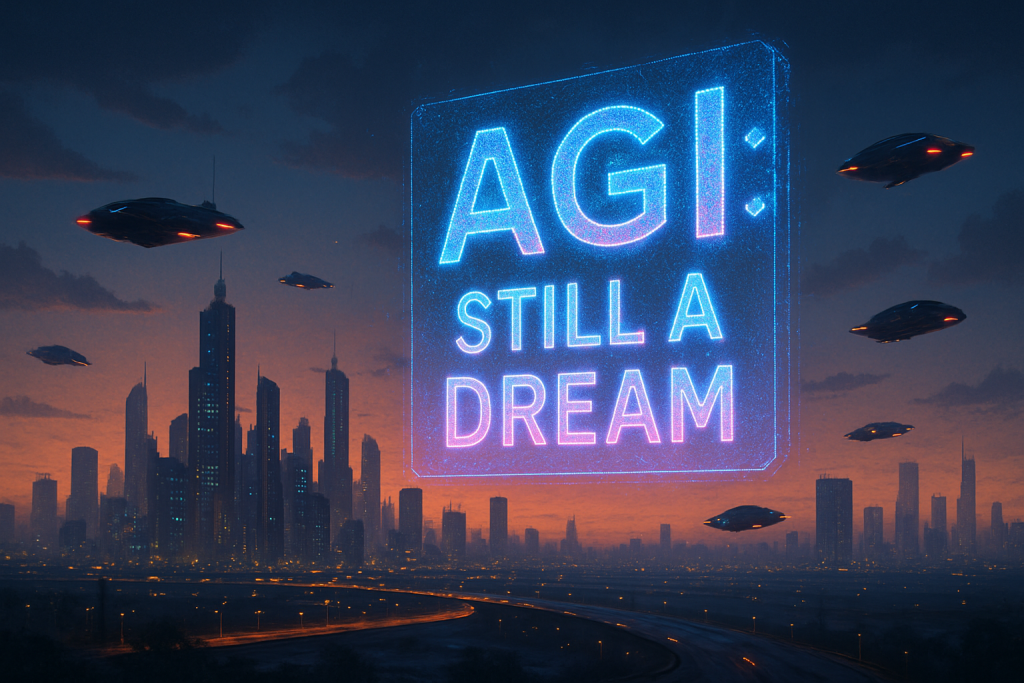

The year is 2025. Flying cars are still a pipe dream (thanks, supply chain!), but AI? That’s everywhere. Or at least, that’s what the hype machine wants you to believe. But hold on to your neural networks, folks, because AI guru Andrew Ng just dropped a truth bomb at the AI Developers Conference, and it’s time we all listened up.
Ng, the man who helped build Google Brain, the guiding force behind Coursera, and the head honcho at DeepLearning.AI, isn’t just some talking head. He’s a legend. Think of him as the Obi-Wan Kenobi of machine learning, and he’s here to tell us that the Force, while strong, isn’t quite ready to overthrow the Empire. In other words, Artificial General Intelligence (AGI), that sci-fi dream of AI that can do anything a human can do, is still a long, long way away.
You might be asking yourself, “AGI? What’s that?” Well, imagine Jarvis from Iron Man, but without the Tony Stark wit (or ego, hopefully). AGI is the holy grail of AI research, a system that can understand, learn, and apply knowledge across a wide range of tasks, just like a human. But according to Ng, we’re still stuck in the “narrow AI” era, where AI excels at specific tasks like image recognition or language translation, but can’t generalize its intelligence to new situations.
Think of it like this: your Roomba is fantastic at vacuuming your floors (most of the time), but it can’t decide what to wear to a job interview. That’s the difference between narrow AI and AGI. We’re really good at building Roombas, but we’re still scratching our heads when it comes to creating a truly intelligent, adaptable machine.
So, what’s holding us back? According to Ng, it’s not just about fancy algorithms and bigger computers (though those help). It’s about the dirty work: data. Preparing data for AI training is a monumental task, and it’s often the unsung hero (or villain, depending on your perspective) of AI development. Garbage in, garbage out, as they say, and even the most sophisticated AI can’t overcome a poorly prepared dataset.
And then there are the dreaded “AI hallucinations.” No, we’re not talking about robots tripping out on virtual LSD (though that would make for a fascinating documentary). AI hallucinations are instances where AI systems generate outputs that are nonsensical, factually incorrect, or just plain bizarre. It’s like asking your GPS for directions and it tells you to drive into a lake. Not ideal.
The Ripple Effects: Who’s Feeling the Pinch?
Ng’s comments come at a crucial time. Investment in generative AI, the kind of AI that can create new content like text, images, and music, is booming. Everyone wants a piece of the AI pie, from tech giants to venture capitalists. But with all that hype comes the risk of overpromising and underdelivering. Ng’s message is a much-needed dose of reality, reminding us that AI, while powerful, is not magic.
And it’s not just investors who need to hear this. Regulators are also starting to pay attention to AI, grappling with questions of bias, fairness, and accountability. As AI becomes more integrated into our lives, from healthcare to finance, the need for responsible AI development becomes paramount. Ng’s emphasis on human oversight is a critical piece of that puzzle. We can’t just unleash AI into the wild and hope for the best. We need to ensure that humans are still in the driver’s seat, guiding its development and mitigating its potential risks.
Ethical Quandaries and the Future of Work
The rise of AI also raises profound ethical questions. What happens to human workers when AI can do their jobs faster and cheaper? How do we ensure that AI systems are fair and unbiased, especially when they’re trained on data that reflects existing societal inequalities? These are not easy questions, and they require careful consideration and open dialogue.
Think of the replicators from Star Trek. They could create anything you wanted, instantly. Sounds amazing, right? But what happens to the economy when scarcity is eliminated? What happens to human purpose when our basic needs are met without effort? The same kinds of questions apply to AI. If AI can automate away most jobs, what will humans do? What will give our lives meaning? These are existential questions, and we need to start grappling with them now, before AI reshapes our world in ways we can’t control.
Ng’s call for realism isn’t about stifling innovation. It’s about fostering a more sustainable and responsible approach to AI development. It’s about recognizing the limitations of current technology and focusing on solving the real-world problems that AI can address, rather than chasing the elusive dream of AGI. It’s about remembering that AI is a tool, and like any tool, it can be used for good or for ill. It’s up to us to ensure that it’s used for the benefit of humanity.
So, the next time you hear someone talking about the imminent arrival of AGI, remember Andrew Ng’s words of wisdom. The future of AI is bright, but it’s also complex and uncertain. Let’s approach it with a healthy dose of skepticism, a commitment to ethical development, and a willingness to embrace the ongoing importance of human involvement. After all, even the smartest AI needs a little help from its friends.
Discover more from Just Buzz
Subscribe to get the latest posts sent to your email.