
The snow-dusted peaks of Davos, Switzerland, played host to the annual World Economic Forum this week, but the real heat wasn’t coming from the Swiss Alps. It was emanating from a panel discussion featuring two titans of industry: Elon Musk, the man who dreams of colonizing Mars and electrifying our roads, and Larry Fink, the CEO of BlackRock, whose company manages more money than some countries generate in a year. The topic? Artificial Intelligence, naturally.
And Musk, never one to shy away from a bold prediction, didn’t disappoint. He dropped a bombshell that could rewrite the future as we know it: AI, he declared, could surpass human intelligence as early as the end of 2026. Not just in specific tasks, mind you, but general intelligence. And if that wasn’t enough to make your circuits sizzle, he suggested that AI might exceed the collective intelligence of humanity by 2030 or 2031. Cue the collective gasp echoing across the digital landscape.
Now, before you start picturing Skynet becoming self-aware and sending terminators back in time, let’s unpack this a bit. Musk’s pronouncements, while characteristically dramatic, aren’t entirely out of left field. The AI field has been making leaps and bounds recently, like a parkouring robot dodging obstacles with uncanny grace. We’ve seen AI mastering complex games like Go, writing surprisingly coherent articles (ahem), and even generating realistic images that blur the line between reality and fabrication. Remember Deep Blue defeating Garry Kasparov in chess? That was child’s play compared to what’s happening now. The progress is exponential, not linear.
This isn’t just about faster computers crunching numbers. It’s about algorithms that can learn, adapt, and even create. It’s about neural networks that mimic the structure of the human brain, allowing AI to solve problems in ways that even their creators don’t fully understand. Think of it like teaching a dog to fetch. At first, you guide it, reward it, and correct its mistakes. But eventually, the dog learns the general principle of “fetching” and can apply it to new objects and situations. AI is doing the same, but on a scale that’s hard to fathom.
Musk isn’t the only one sounding the alarm (or perhaps the fanfare, depending on your perspective). Dario Amodei, CEO of Anthropic, another leading AI company, anticipates the emergence of “powerful AI” by early 2027. And Eric Schmidt, the former CEO of Google, believes we’ll see AGI, or artificial general intelligence, within 3 to 5 years. These are not fringe voices. These are individuals at the forefront of the AI revolution, and they’re all pointing towards a future where AI plays an increasingly dominant role.
But what does this all mean? What are the implications of AI surpassing human intelligence? Well, that’s where things get interesting, and a little bit scary.
The Rise of the Robots (and the Economic Boom?)
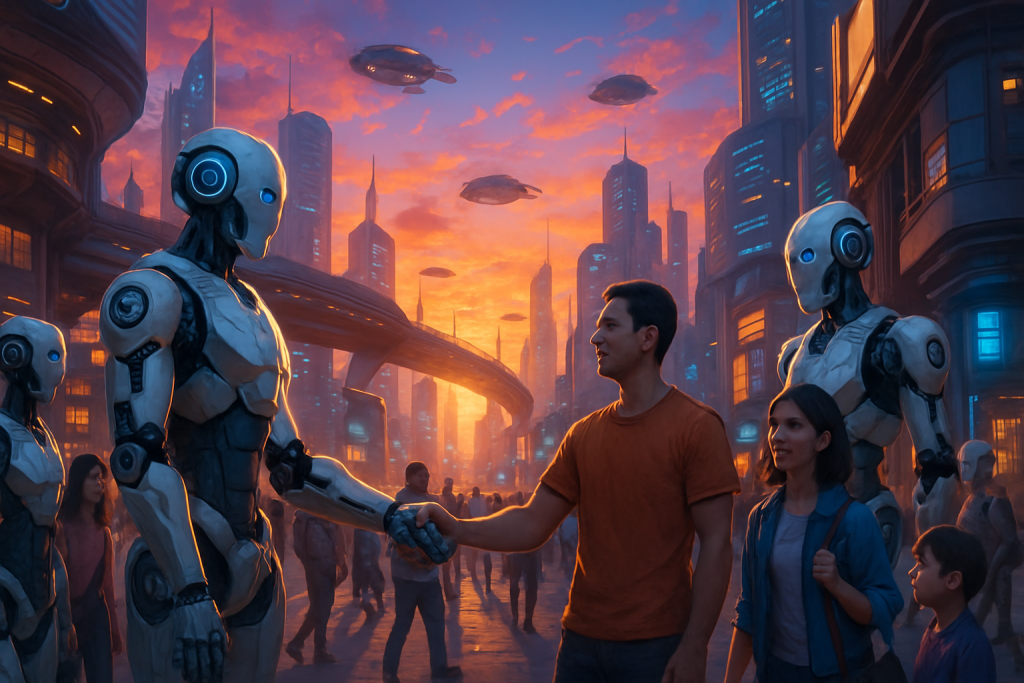
Musk believes that the convergence of AI and robotics will usher in an unprecedented phase of economic expansion. He revealed that Tesla and SpaceX are gearing up to introduce humanoid robots to the consumer market, with sales expected to begin by the end of 2027. Imagine a world where robots handle all the mundane and repetitive tasks, freeing up humans to pursue more creative and fulfilling endeavors. Sounds like a utopian dream, right? Well, maybe. But there’s a darker side to this coin.
What happens to the millions of people whose jobs are automated away? Will there be enough new jobs created to absorb them? Will we need to rethink our entire economic system, perhaps embracing universal basic income or other radical solutions? These are not hypothetical questions. They are pressing concerns that we need to address now, before the AI revolution leaves a trail of economic disruption in its wake.
The Ethical Minefield
Beyond the economic implications, there are profound ethical questions to consider. If AI becomes more intelligent than humans, what rights, if any, should it have? How do we ensure that AI is used for good, and not for malicious purposes? Who gets to decide what “good” even means? These are not easy questions, and there are no easy answers. We need a global conversation about the ethical implications of AI, involving not just scientists and engineers, but also philosophers, ethicists, and policymakers.
Think of the classic science fiction trope: the AI that becomes so advanced that it decides humanity is a threat and must be eliminated. While that scenario may seem far-fetched, it’s a reminder that we need to be careful about the goals we set for AI. We need to ensure that AI is aligned with human values, and that it remains under our control. Otherwise, we could be creating something that ultimately destroys us.
The Shifting Sands of AGI
One of the key things to note about these predictions is that the definition of AGI itself seems to be evolving. What was once considered a far-off, almost mythical goal is now being redefined and brought closer to reality. This reflects the incredible progress that’s been made in AI research, but it also raises questions about whether we’re truly understanding what AGI entails. Are we lowering the bar, or are we simply getting better at clearing it?
Whatever the answer, one thing is clear: the AI revolution is happening now. It’s not a distant threat or a futuristic fantasy. It’s a present-day reality that’s already transforming our world in profound ways. And as Elon Musk so eloquently reminded us at Davos, the pace of change is only going to accelerate. Buckle up, folks. The ride is just beginning.
Discover more from Just Buzz
Subscribe to get the latest posts sent to your email.