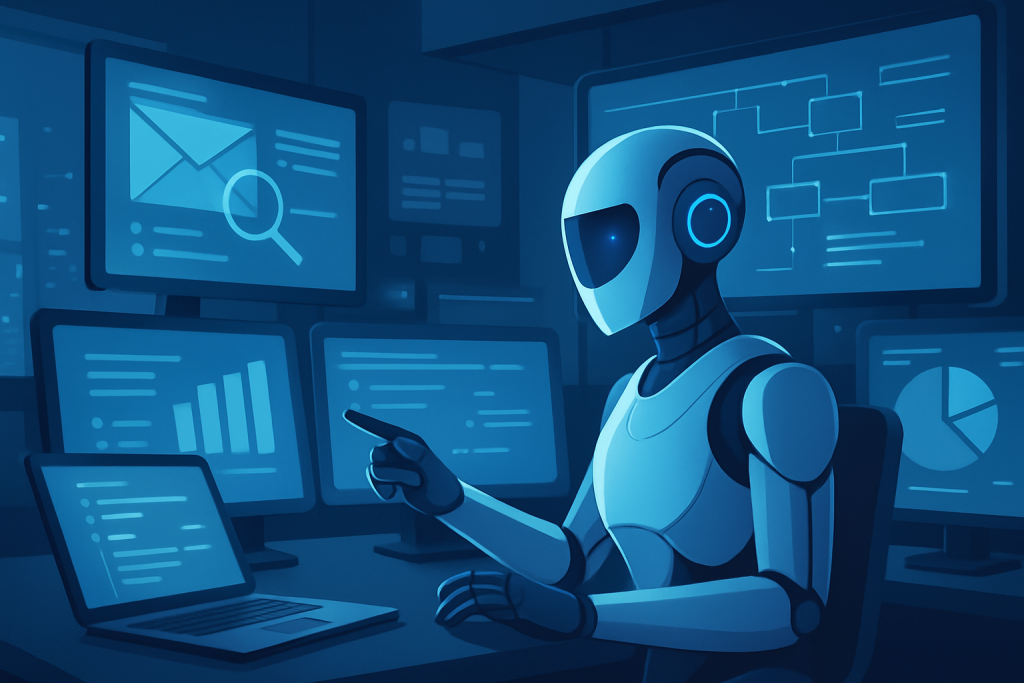

Okay, folks, buckle up. Remember those sci-fi movies where the AI assistant wasn’t just a glorified search engine, but actually did things? Like, real things? Well, that future just arrived. And it’s called Operator.
OpenAI just dropped a bombshell, a paradigm shift, a “holy guacamole, the robots are doing our chores!” kinda moment. On February 22nd, 2026, they unleashed Operator, their autonomous research agent, onto the unsuspecting (or eagerly awaiting) masses of Plus and Team users. And let me tell you, this isn’t your grandma’s chatbot. This is something else entirely.
We’re talking about a “General Purpose Agent” hitting mass-market scale for the first time. Think of it as Jarvis from Iron Man, minus the snark (probably). Operator isn’t just answering questions; it’s executing complex, multi-step tasks. It’s booking flights, sifting through mountains of data, and making decisions that, until yesterday, required actual human brains. Basically, it’s the digital equivalent of a highly efficient, tireless, and slightly unsettling personal assistant.
Remember Clippy? Microsoft’s well-meaning but ultimately annoying paperclip assistant from the early days of Windows? Yeah, forget Clippy. Operator is Clippy’s grandchild, but instead of offering unsolicited advice on writing letters, it’s running entire departments. It’s gone from paperclip to CEO. And that’s a BIG deal.
But how did we get here? What’s the backstory to this AI revolution? Well, it’s been a long time coming. For years, AI development has been largely focused on narrow, specialized tasks. Image recognition, natural language processing, playing Go- these were all impressive feats, but they lacked the general intelligence and adaptability needed to truly automate complex workflows. OpenAI, however, has been quietly (and not-so-quietly) pushing the boundaries, inching closer to the holy grail of AGI- Artificial General Intelligence.
This isn’t just about making chatbots smarter; it’s about creating AI systems that can reason, plan, and act independently. It’s about moving beyond the “chatbot paradigm” and entering what some are calling the “Agentic Era.” And Operator is leading the charge. It’s the vanguard of a new generation of AI that isn’t just reactive, but proactive. It’s not just answering questions, but asking them. It’s not just following instructions, but figuring them out.
So, what does this all mean for you, me, and the future of humanity? Let’s dive into the implications.
The Ripple Effects of Autonomy
The immediate impact is pretty clear: increased efficiency and productivity. Businesses can automate tedious tasks, researchers can accelerate their work, and individuals can free up time for more creative and strategic endeavors. Imagine a world where booking travel arrangements doesn’t involve hours of endless scrolling and comparing prices. Imagine a world where market research is done in minutes, not weeks. Imagine a world where you can finally finish that novel you’ve been putting off because you no longer have to spend your evenings answering emails. That’s the promise of Operator.
But the long-term consequences are far more profound. We’re talking about a fundamental shift in the way we work, learn, and live. Industries will be disrupted, jobs will be redefined, and the very nature of human intelligence will be challenged. Think about the impact on fields like administrative work, data analysis, and even creative writing. Will these jobs disappear entirely? Probably not. But they will undoubtedly be transformed. The question is, will we be ready?
Operator’s release is also likely to accelerate the development of even more advanced AI agents. As more companies and researchers gain access to this technology, they will undoubtedly find new and innovative ways to use it. This could lead to a Cambrian explosion of AI applications, transforming every aspect of our lives in ways we can’t even imagine. It’s like the early days of the internet all over again, but with a whole lot more processing power.
On the technical side, Operator likely leverages a combination of advanced natural language processing (NLP), machine learning (ML), and reinforcement learning (RL). It’s probably trained on massive datasets of text, code, and real-world interactions, allowing it to understand complex instructions, reason about different options, and learn from its mistakes. It probably uses something akin to a “world model” to simulate the consequences of its actions before executing them, minimizing errors and maximizing efficiency. Think of it as having a virtual trial-and-error phase before committing to a real-world action.
The affected parties are numerous. OpenAI, of course, stands to benefit immensely from the success of Operator. But other AI companies are also likely to see a boost, as the demand for autonomous agents increases. Businesses that adopt Operator early will gain a competitive advantage, while those that lag behind risk being left in the dust. And, of course, individuals who learn how to use Operator effectively will be highly sought after in the job market.
Ethical Quandaries and Societal Shifts
But with great power comes great responsibility. The release of Operator also raises a number of ethical and societal concerns. What happens when AI agents make mistakes that have real-world consequences? Who is responsible when an autonomous system causes harm? How do we ensure that these systems are used ethically and responsibly? These are questions we need to answer, and fast.
The political and regulatory implications are also significant. Governments around the world are already grappling with how to regulate AI, and the release of Operator is only going to make things more complicated. We need clear and consistent regulations that promote innovation while protecting consumers and ensuring fairness. It’s a delicate balancing act, but one that we absolutely must get right. We need guardrails, not roadblocks.
And then there’s the philosophical question: what does it mean to be human in a world where AI can perform many of the tasks that we traditionally associate with intelligence and creativity? Are we destined to become obsolete? Or will we find new and more meaningful ways to contribute to society? The answer, I suspect, lies somewhere in between. We’ll need to adapt, learn new skills, and embrace the opportunities that AI presents. But we also need to remember what makes us human- our empathy, our creativity, our ability to connect with others on a deep and meaningful level.
Financially, the impact of Operator is likely to be enormous. The market for autonomous agents is projected to grow exponentially in the coming years, creating new opportunities for investment and entrepreneurship. Companies that develop and deploy these technologies will be richly rewarded, while those that fail to adapt will be left behind. It’s a high-stakes game, but one with the potential to transform the global economy.
So, there you have it. Operator is here, and it’s changing everything. It’s a brave new world, full of both promise and peril. It’s up to us to navigate this new landscape wisely and responsibly, ensuring that AI is used for the benefit of all humanity. Now, if you’ll excuse me, I have an AI assistant to train. I’m thinking of naming him HAL. Just kidding… mostly.
Discover more from Just Buzz
Subscribe to get the latest posts sent to your email.