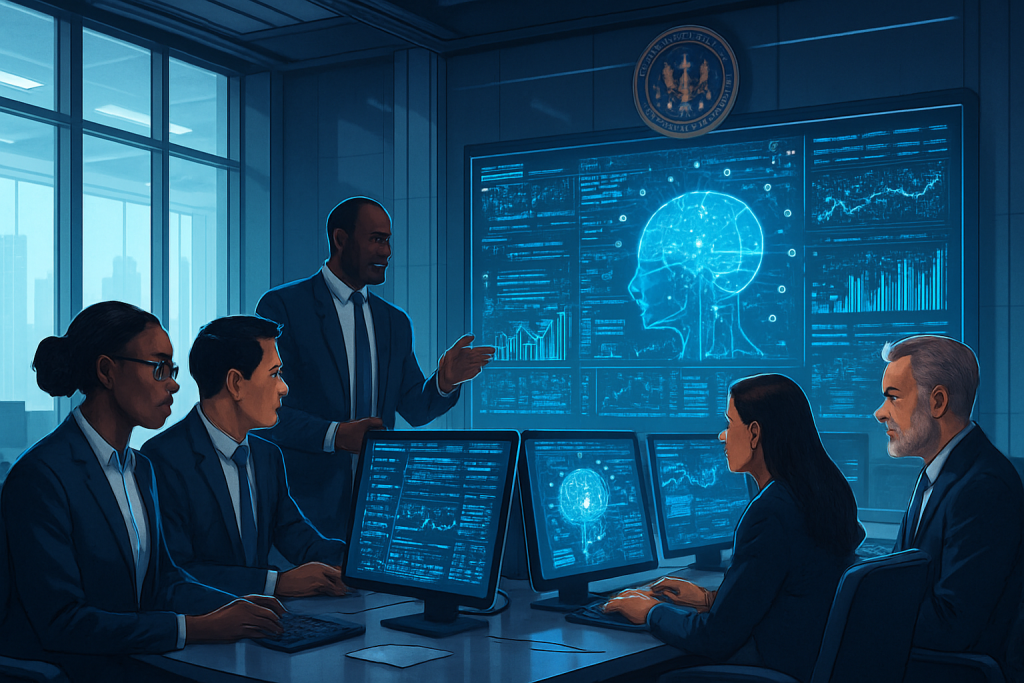

The date is March 19, 2026. Forget flying cars; the real future is already here, and it’s wearing a government-issue suit. The United States General Services Administration (GSA) just dropped a bombshell, or perhaps a precisely targeted data payload, announcing that U.S. Chief Information Officer Gregory Barbaccia will now also serve as Acting Director for Technology Transformation Services (TTS) *and* Senior Advisor to the Administrator. That’s a lot of titles, but what does it all mean? Simply put, Barbaccia is now the point person for the federal government’s all-in push on artificial intelligence.
Think of it like this: the government is finally ready to stop treating AI like some futuristic sci-fi trope and start using it to, well, actually govern. And Barbaccia, with his interesting background, is the one tasked with making sure it doesn’t turn into a Skynet situation. More on that later.
But first, let’s unpack the context, because this wasn’t some random decision pulled out of a digital hat.
From Palantir to Public Service: Barbaccia’s Backstory
Barbaccia isn’t your typical Beltway bureaucrat. He’s an Army intelligence veteran who traded tactical maps for technological roadmaps. Before entering government service in January 2025 under the previous administration, he spent a decade at Palantir Technologies. Yes, *that* Palantir, the data integration and analysis powerhouse often shrouded in mystery and intrigue. Think of them as the real-world version of the Department of Pre-Crime from “Minority Report,” but hopefully with better ethical oversight. He also held senior positions at startups Theorem and Elementus, giving him a trifecta of experience: defense, big data, and the agile world of startups. This blend of experience is key. He understands the potential of AI, the security risks, and the need for nimble adaptation.
This background is crucial because it speaks to a growing trend: governments are no longer afraid to bring in talent from the private sector, even those with connections to companies that might raise eyebrows. The thinking is simple: if you want to fight fire with fire, you need someone who knows how to play with matches, but also how to control the blaze.
The Mission: AI for All (Well, at Least All Government Agencies)
So, what’s Barbaccia actually *doing* in this new role? The official line is that he’s focused on strengthening cross-agency partnerships and scaling secure, mission-aligned technologies for the American public. In other words, he’s trying to get all the different government departments to play nicely together when it comes to AI. Think of it as wrangling a bunch of highly intelligent, but sometimes temperamental, AIs into a cohesive team. Good luck with that, Greg!
This appointment arrives at a crucial moment. The federal government is doubling down on AI integration. The goal? To boost efficiency, tighten security, and deliver better services. Imagine AI-powered chatbots that can actually answer your questions about taxes, or algorithms that can predict and prevent cyberattacks on critical infrastructure. That’s the vision, anyway. The reality, as always, is likely to be a bit more complex and involve a few more glitches along the way.
Implications: A Technological Tsunami or a Gentle Wave?
Barbaccia’s appointment is more than just a personnel shuffle. It signals a major shift in how the government views and utilizes AI. Here’s a breakdown of the potential implications:
For Taxpayers: The GSA is promising “maximum value.” Theoretically, AI-driven efficiencies could lead to lower costs and better services. But history tells us that government technology projects rarely go as planned. Will this be another boondoggle, or will it actually deliver on its promises?
For Government Employees: The rise of AI inevitably leads to concerns about job displacement. Will government workers be replaced by algorithms? The official line is that AI will augment human capabilities, not replace them. But the reality is likely to be a mix of both. Some jobs will evolve, others will disappear, and new ones will emerge. The key will be retraining and adaptation.
For Tech Companies: This appointment is a green light for tech companies to aggressively pursue government contracts. Expect a bidding war among AI vendors vying for a piece of the pie. Palantir, given Barbaccia’s history, will likely be a major player. But smaller, more innovative startups could also benefit if they can offer specialized solutions.
For National Security: AI is a game-changer in national security. It can be used for everything from analyzing satellite imagery to predicting terrorist attacks. But it also raises serious ethical questions about surveillance and the potential for autonomous weapons. Barbaccia’s background in Army intelligence suggests a strong focus on security, but it also raises concerns about privacy and civil liberties.
The Ethical Minefield: Can We Trust the Algorithm?
Speaking of ethics, the government’s embrace of AI raises a host of thorny questions. Who is responsible when an AI makes a mistake? How do we ensure that algorithms are fair and unbiased? How do we prevent AI from being used to manipulate or control citizens?
These are not just abstract philosophical debates. They have real-world consequences. Imagine an AI-powered sentencing algorithm that disproportionately punishes certain racial groups. Or an AI-driven healthcare system that denies treatment to patients based on flawed data. The potential for harm is enormous.
The government needs to establish clear ethical guidelines and oversight mechanisms to ensure that AI is used responsibly and ethically. This includes transparency, accountability, and the right to appeal. We need to know how these algorithms are making decisions and who is responsible when things go wrong.
The Global Race: AI Domination or Cooperative Future?
The United States isn’t the only country racing to embrace AI. China, Russia, and other nations are investing heavily in this technology. This creates both opportunities and risks.
On the one hand, AI could lead to breakthroughs in healthcare, education, and other areas that benefit all of humanity. On the other hand, it could exacerbate existing inequalities and create new forms of conflict. A global arms race in AI could be catastrophic. We need to foster international cooperation and establish common ethical standards to ensure that AI is used for good, not evil.
Barbaccia’s appointment is a signal. The government is serious about AI, and it’s betting that he can navigate the complex technological, ethical, and political landscape. Whether he succeeds remains to be seen. But one thing is clear: the future is here, and it’s powered by algorithms.
Discover more from Just Buzz
Subscribe to get the latest posts sent to your email.