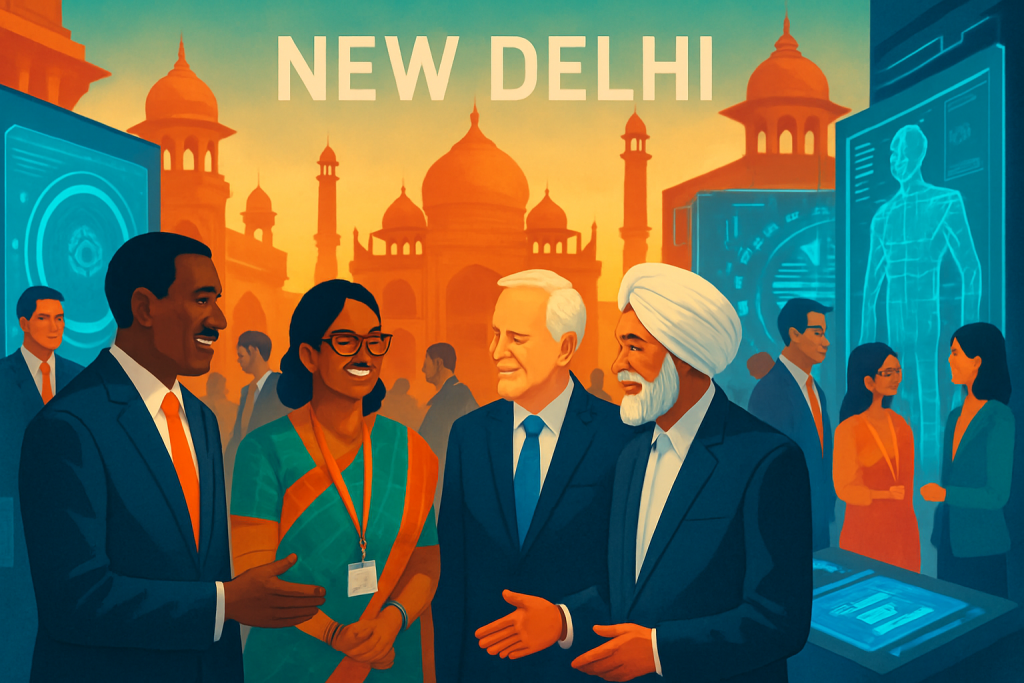

The air in New Delhi crackled with more than just anticipation this past week. It hummed with the digital heartbeat of the future, as the AI Impact Summit drew to a close at the Bharat Mandapam conference hall. Think of it as Davos, but instead of snow-capped mountains, you have cutting-edge AI demos and the spicy aroma of samosas filling the air. The summit, running from February 16th to 21st, 2026, wasn’t just another tech conference; it was a pivotal moment, a declaration of intent from the Global South, orchestrated from the heart of India.
Fifteen heads of state graced the event, a veritable who’s who of global leadership, including French President Emmanuel Macron and Indian Prime Minister Narendra Modi. The digital glitterati were out in force too, with CEOs from Google, OpenAI, and Anthropic all vying for attention and influence. Tens of thousands flocked to witness the unveiling of what India hopes will be a new era of AI development, one less beholden to the existing superpowers.
The summit culminated in a joint declaration, a document long on aspiration, if admittedly somewhat short on concrete, legally binding commitments. It was more of a vibe check, a global consensus that generative AI represents “an inflection point,” a moment of profound change akin to the invention of the printing press or the debut of the first iPhone. The declaration emphasized the crucial need for secure and, crucially, energy-efficient AI systems. Why energy-efficient? Because training these behemoth models guzzles power like a supervillain draining a city’s grid in a Marvel movie. And as anyone who’s tried to mine crypto knows, energy consumption is a very real concern.
But beneath the surface of diplomatic pleasantries and tech demos, a more significant narrative was unfolding: India’s ambition to champion AI development across the Global South. Forget the Cold War; this is the Algorithm War, and India doesn’t want to be a mere spectator. They envision a “third way,” a path independent of the U.S. and Chinese dominance that currently defines the AI landscape. Think less East versus West, and more a collaborative, decentralized approach, leveraging the unique needs and talents of developing nations.
India isn’t just talking the talk; they’re walking the walk or, perhaps more accurately, coding the code. The IndiaAI mission, launched in 2025, aims to build sovereign AI capacity. At the summit, they proudly unveiled their first open-source language model. It’s a bold move, akin to releasing the schematics for the Death Star (minus the planet-destroying capability, of course). By open-sourcing their model, India is inviting collaboration, fostering innovation, and ensuring that AI development isn’t locked away in the ivory towers of Silicon Valley or Beijing.
The scale of India’s ambition is staggering. They’ve already released 7,000 public datasets, a treasure trove of information designed to fuel the creation of specialized AI models. Imagine AI tailored to the specific needs of Indian farmers, healthcare workers in rural communities, or educators in underserved schools. This isn’t about generic AI; it’s about creating solutions that address the unique challenges and opportunities of the Global South.
One particularly intriguing initiative is the Indo-French collaboration on multilingual and energy-efficient AI. It’s a partnership that could yield significant breakthroughs, combining France’s expertise in AI research with India’s vast linguistic diversity. Think of a universal translator that works seamlessly across hundreds of languages, breaking down communication barriers and fostering greater understanding between cultures. It’s like the Babel fish from *The Hitchhiker’s Guide to the Galaxy*, only (hopefully) less slimy.
And speaking of solutions, India, in partnership with UNESCO, launched a challenge focused on sustainable AI solutions. Because let’s face it, AI can be a double-edged sword. While it holds immense potential for good, it also raises concerns about job displacement, algorithmic bias, and, as we’ve already discussed, energy consumption. The UNESCO challenge aims to harness AI’s power to address these challenges, promoting responsible and sustainable development.
The financial implications of this AI push are enormous. India hopes to attract $200 billion in data center investments. That’s a lot of servers, a lot of cooling systems, and a lot of potential jobs. They’ve also approved $18 billion in semiconductor projects, a critical step in building a domestic AI hardware ecosystem. After all, you can’t run cutting-edge AI models on outdated hardware. It’s like trying to play *Cyberpunk 2077* on a Commodore 64- it’s just not going to happen.
The New Delhi declaration also touched on the societal benefits of multilingual AI translation (bridging those communication gaps), the looming shadow of job disruption (a concern that needs careful consideration), and the insatiable energy appetite of data centers (a problem that demands innovative solutions). It acknowledged the importance of security in AI systems, emphasizing industry-led voluntary measures and the adoption of technical solutions and policy frameworks that enable innovation while safeguarding the public interest. It’s a delicate balancing act, ensuring that AI serves humanity, not the other way around.
The AI Impact Summit in New Delhi wasn’t just a conference; it was a statement. It was India stepping onto the world stage, not just as a consumer of AI technology, but as a leader, an innovator, and a champion for the Global South. Whether they can successfully navigate the complex challenges ahead remains to be seen. But one thing is clear: the future of AI is being written not just in Silicon Valley and Beijing, but in New Delhi too.
Discover more from Just Buzz
Subscribe to get the latest posts sent to your email.