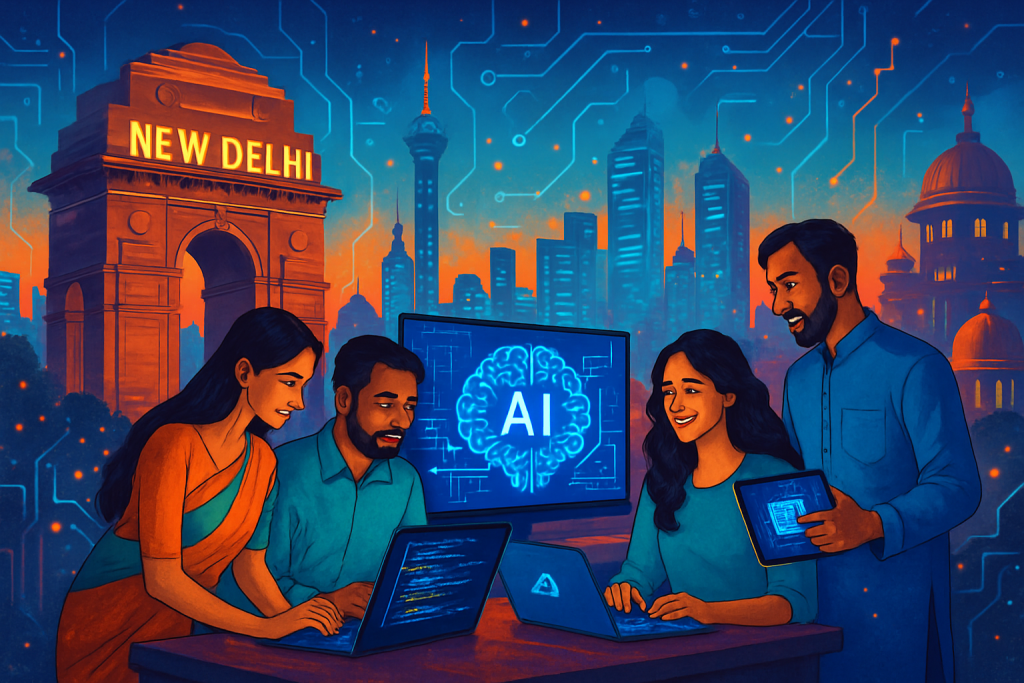

The year is 2026. Self-driving cars are (mostly) a thing, your fridge orders groceries before you run out, and the debate about whether AI will steal all our jobs has morphed into a more nuanced discussion about how we co-exist. Against this backdrop, something significant happened yesterday in New Delhi: Indian Prime Minister Narendra Modi, speaking at the India AI Impact Summit, declared India’s ambition to be a central force in the global AI landscape. His message was clear: “Design and develop in India. Deliver to the world. Deliver to humanity.” It’s a bold statement, reminiscent of the space race rhetoric of the ’60s, but instead of reaching for the moon, India is aiming for AI dominance.
But what’s the real story behind this ambition? It’s not just about technological prowess; it’s about geopolitics, economics, and a vision for a more equitable AI future. Think of it as India throwing its hat into the ring, not just to compete with the US and China, but to offer a different, perhaps more inclusive, approach to AI development.
The India AI Impact Summit, the fourth in a series following events in the UK, South Korea, and France, is a big deal for a few reasons. First, it’s the first time a Global South nation has hosted such a prestigious gathering. This isn’t just about India flexing its tech muscles; it’s about signaling a shift in the AI power dynamic. For years, the narrative has been dominated by Silicon Valley giants and Chinese tech behemoths. Now, India is saying, “Hold on, we have a seat at this table.”
Second, the summit itself is a platform for discussing the future of AI in a globalized world. Modi’s key message revolved around democratizing AI, making it accessible and beneficial for everyone, especially developing nations. He emphasized that AI should be a tool for inclusion and empowerment, a sentiment echoed by UN Secretary-General António Guterres, who called for a $3 billion fund to help poorer countries build basic AI capacity. It’s a stark contrast to the often-cited fears of AI exacerbating existing inequalities, a fear that’s been explored in countless dystopian sci-fi flicks, from “Blade Runner” to “Ex Machina.”
But how does India plan to achieve this ambitious goal? The answer lies in its vast digital infrastructure. With nearly a billion internet users, India has become a prime market for global tech companies. More importantly, it has experience in building large-scale digital public infrastructure, like its Aadhaar biometric ID system and its Unified Payments Interface (UPI). These systems, while not without their controversies, demonstrate India’s ability to deploy technology at scale. The idea is to leverage this experience to create a cost-effective hub for AI innovation, attracting talent and investment while developing solutions tailored to the needs of the Global South.
Let’s break down the technical implications a bit further. India isn’t just talking about building generic AI models; it’s focusing on developing AI solutions that address specific challenges faced by developing nations. Think AI-powered healthcare diagnostics for remote areas, AI-driven agricultural solutions to improve crop yields, or AI-based educational tools to bridge the digital divide. These are not just abstract ideas; they are concrete applications with the potential to transform lives. The core technology will likely involve a combination of machine learning, natural language processing, and computer vision, all adapted to the unique data and infrastructure constraints of developing countries. For example, AI models might need to be trained on smaller datasets or optimized to run on low-power devices.
The financial and economic impact of this push is potentially enormous. If India succeeds in becoming a global AI hub, it could attract billions of dollars in investment, create millions of jobs, and boost its overall economic growth. But it’s not just about India’s economic gain; it’s about the potential for AI to drive economic development across the Global South. Imagine a scenario where AI-powered tools help smallholder farmers in Africa increase their yields, or where AI-based education platforms provide access to quality education for children in remote villages. The possibilities are truly transformative.
Of course, there are challenges. Ethical considerations are paramount. How do we ensure that AI systems are fair, transparent, and accountable? How do we protect data privacy and prevent bias in AI algorithms? These are questions that need to be addressed proactively, not as an afterthought. The political landscape is also complex. India will need to navigate the geopolitical tensions between the US and China, while also forging partnerships with other countries in the Global South. The key will be to maintain a neutral stance and focus on collaboration and shared goals.
Ultimately, Modi’s address at the India AI Impact Summit represents a bold vision for the future of AI. It’s a vision that emphasizes inclusivity, equity, and the potential for AI to transform lives across the globe. Whether India can deliver on this vision remains to be seen, but one thing is clear: the global AI landscape is becoming increasingly multipolar, and India is determined to be a major player.
Discover more from Just Buzz
Subscribe to get the latest posts sent to your email.