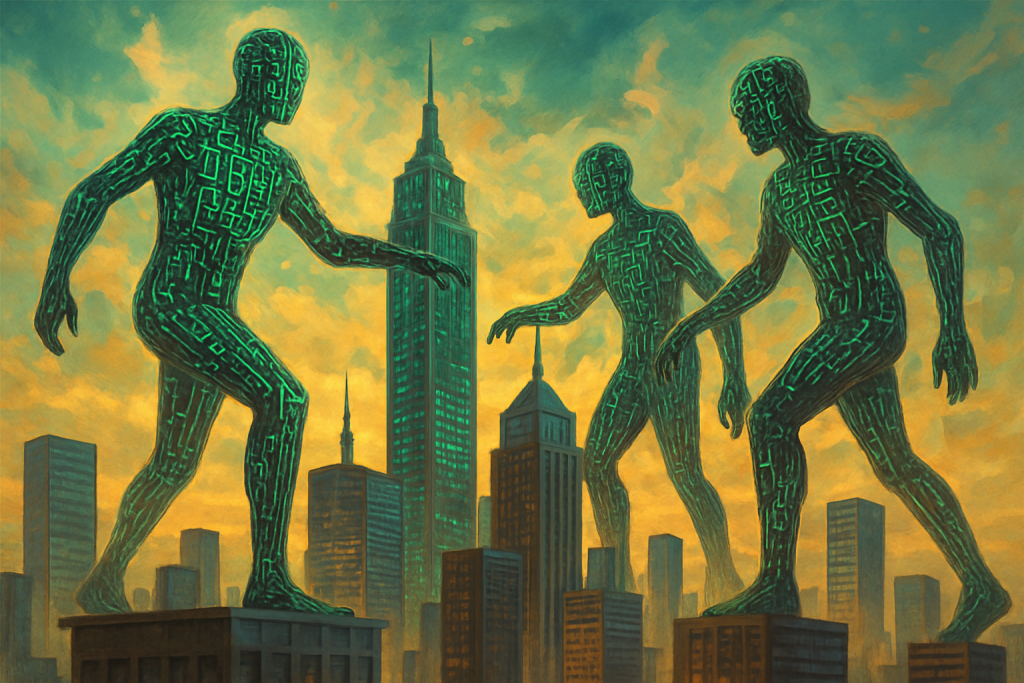

The year is 2025. Flying cars, still just a pipe dream. Robot butlers, not quite ready to replace Jeeves. But one thing has undeniably, irrevocably, and perhaps even a little bit terrifyingly arrived: Artificial Intelligence. And Time magazine, in a move that feels both inevitable and slightly apocalyptic, has named the “Architects of AI” as its Person of the Year.
Forget individual accolades; this isn’t about one singular visionary. This is a collective, a pantheon of individuals and teams who have, in the past few years, fundamentally reshaped our world. Think of it as the Avengers, but instead of saving us from Thanos, they’ve unleashed algorithms that can write poetry, diagnose diseases, and potentially, one day, decide whether or not you get that promotion. A bit more frightening than super villains, isn’t it?
Time’s Editor-in-Chief, Sam Jacobs, put it bluntly: 2025 is the point of no return. We’re not going back to a pre-AI world. The genie, or perhaps more accurately, the silicon-based entity, is out of the bottle. The news is reverberating across the tech landscape, igniting a flurry of discussions about what this recognition truly means. It’s not just a pat on the back; it’s an acknowledgement of a power shift, a fundamental transformation of society.
And who are these architects? Let’s break down the Mount Rushmore of the AI revolution, the faces staring back at us from the cover of Time, in a pose deliberately reminiscent of the iconic “Lunch atop a Skyscraper” photograph – a potent symbol of building something monumental, something that reshapes the skyline. Instead of steel girders, though, they’re balancing precariously on lines of code.
There’s Jensen Huang, the CEO of Nvidia, the man who essentially sells the shovels in this AI gold rush. His company’s GPUs aren’t just for gamers anymore; they’re the engines that power the massive neural networks driving everything from self-driving cars to medical breakthroughs. Without Nvidia’s hardware, much of the recent AI explosion simply wouldn’t have been possible.
Then we have Sam Altman, the CEO of OpenAI, the company that brought us GPT-5.2, the latest iteration of the language model that can write essays, generate code, and even hold a (somewhat stilted) conversation. Altman is the face of the AI chatbot revolution, the guy who made AI accessible to the masses, even if it sometimes hallucinates historical facts or develops a strangely aggressive personality. Remember Tay, Microsoft’s ill-fated AI chatbot from a few years back? GPT-5.2 is Tay’s much, much smarter, and hopefully less racist, cousin.
Elon Musk, of course, couldn’t be left out. The man who wants to colonize Mars and build brain-computer interfaces is also deeply involved in AI, through X (formerly Twitter) and various other ventures. He’s the wild card, the unpredictable element in the equation, always pushing the boundaries of what’s possible, even if it means occasionally setting fire to the furniture. His constant refrain of AI safety is a constant reminder that with great power comes great responsibility, even if he’s not always the best at wielding that power responsibly.
Mark Zuckerberg, the CEO of Meta, is also present. Meta’s all-in bet on the metaverse may not have paid off in the way he planned, but their massive investments in AI infrastructure are undeniable. From improving ad targeting (shudder) to powering new augmented reality experiences, Meta is weaving AI into the fabric of our digital lives. And let’s not forget their open-source AI initiatives, a move that both democratizes the technology and potentially opens Pandora’s Box.
Demis Hassabis, the CEO of DeepMind, represents the more academic, research-focused side of the AI world. DeepMind’s AlphaGo program famously defeated the world’s best Go players, a feat that was once considered impossible. They’re now tackling some of the biggest challenges facing humanity, from drug discovery to climate change, using AI as a powerful tool for scientific advancement.
Lisa Su, CEO of AMD, joins Huang in representing the hardware backbone of the AI revolution. While Nvidia has dominated the GPU market, AMD is rapidly catching up, offering competitive solutions that are driving down prices and making AI more accessible. It’s a classic tech rivalry, reminiscent of the Intel versus AMD battles of the past, but this time the stakes are much higher.
Dario Amodei, CEO of Anthropic, is a key figure in the increasingly important field of AI safety. Anthropic is focused on building AI systems that are aligned with human values, ensuring that these powerful technologies are used for good, not evil. They’re essentially the ethical watchdogs of the AI world, the guardians of our digital future.
Finally, there’s Fei-Fei Li, Co-Director of the Stanford Human-Centered AI Institute. Li is a leading voice in the debate about ethical AI development, advocating for a more inclusive and responsible approach to AI research. She’s the conscience of the AI revolution, reminding us that technology should serve humanity, not the other way around.
The inclusion of these individuals underscores the multifaceted nature of the AI revolution. It’s not just about algorithms and code; it’s about hardware, ethics, safety, and the human impact. It’s a complex web of interconnected forces, all shaping our future in profound ways.
But what are the broader implications of this recognition? Beyond the accolades and the magazine covers, what does it mean for the world? For starters, it signals a shift in the cultural narrative. AI is no longer a futuristic fantasy; it’s a present-day reality. It’s impacting everything from the jobs we do to the way we consume information to the very fabric of our social interactions.
The economic impact is undeniable. AI is driving innovation across industries, creating new markets and disrupting old ones. Companies that embrace AI are thriving, while those that resist are falling behind. It’s a winner-takes-all scenario, and the stakes are incredibly high.
Politically, the rise of AI is raising complex questions about regulation, governance, and national security. Governments around the world are grappling with how to manage this powerful technology, balancing the need to foster innovation with the imperative to protect citizens from potential harm. The debate over AI regulation is only going to intensify in the years to come.
And then there are the ethical considerations. As AI becomes more sophisticated, it raises fundamental questions about bias, fairness, and accountability. Who is responsible when an AI system makes a mistake? How do we ensure that AI is used to promote equality and justice, rather than perpetuate existing inequalities? These are not just abstract philosophical questions; they are real-world challenges that demand urgent attention.
The “Architects of AI” being named Time’s Person of the Year is more than just a symbolic gesture. It’s a wake-up call. It’s a recognition that we are living in a new era, an era defined by artificial intelligence. And it’s a reminder that we all have a role to play in shaping the future of this technology, ensuring that it is used to build a better world for all.
Discover more from Just Buzz
Subscribe to get the latest posts sent to your email.