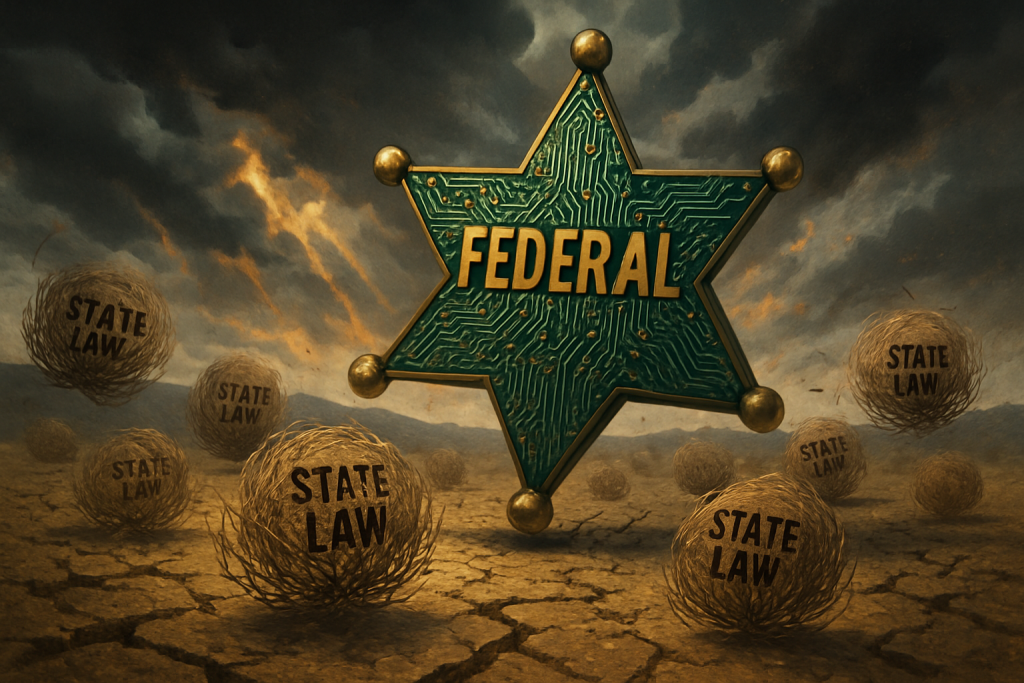

Hold on to your hats, folks, because the AI landscape just got a whole lot more… interesting. President Trump, never one to shy away from shaking things up, dropped an executive order yesterday that’s got everyone from Silicon Valley CEOs to state governors buzzing like a server farm on overdrive. The gist? He’s putting the brakes on individual states from enacting their own AI regulations, aiming for a unified, nationwide approach. Think of it as a digital Wild West showdown, with the Feds stepping in as the new sheriff in town.
But before you start picturing tumbleweeds of code rolling across the plains, let’s unpack this. What exactly did the President do, and why is it such a big deal?
The executive order, signed on December 12, 2025, is essentially a preemptive strike. It instructs federal agencies to actively challenge state laws that are deemed to be hindering AI innovation. And the kicker? The administration is threatening to withhold federal funding from states that don’t play ball. Yes, you read that right- federal funding at risk if states try to regulate AI in their own way.
This isn’t happening in a vacuum, of course. Several states, including tech-heavyweights like California and forward-thinking locales like Colorado, Utah, and Texas, have already been busy crafting their own AI regulations. These laws cover everything from demanding transparency in AI algorithms to placing limits on how companies collect and use our personal data. California’s SB-53, the Transparency in Frontier Artificial Intelligence Act, for instance, is all about making sure AI companies assess and mitigate potential “catastrophic risks.” It’s like requiring Godzilla to take a safety course before rampaging through Tokyo.
So why the federal intervention? The Trump administration argues that this patchwork of state laws could stifle innovation and put the U.S. at a disadvantage against countries like China, which have more centralized AI governance. They envision a streamlined system where AI developers can operate under a single set of rules across the entire country, rather than navigating a confusing maze of state-specific regulations. Think of it as standardizing the charging ports for all your devices- makes life a whole lot easier, right?
The Legal and Political Minefield
But here’s where things get complicated. The executive order is already facing a barrage of criticism, both legal and political. Legal experts are questioning whether the administration even has the authority to override state laws in this way. It’s a classic federalism debate, reminiscent of the battles over environmental regulations or healthcare. Can the feds really tell states what to do when it comes to AI?
One of the biggest sticking points is the threat to withhold federal funding. The order specifically mentions programs like the $42 billion Broadband Equity, Access, and Deployment (BEAD) program, which is crucial for expanding internet access in rural areas. This is where things get particularly spicy, because those rural areas are often a key part of President Trump’s support base. Threatening to cut off their broadband funding could backfire spectacularly. It’s a bit like cutting off your nose to spite your face, or, perhaps more accurately, cutting off your internet access to spite California.
And let’s not forget the Constitution. The administration is reportedly leaning on the interstate commerce clause to justify its actions, arguing that state AI regulations could unfairly discriminate against out-of-state businesses. But past attempts to use the “dormant commerce clause” to strike down state tech regulations haven’t exactly been slam dunks. The administration will need to prove that states are actively discriminating against companies from other states, a high hurdle to clear.
Winners, Losers, and the Rise of Skynet (Maybe)
So, who stands to gain from all this? The tech industry, for one. Many tech companies have been lobbying for a unified national AI framework, arguing that it will make it easier to develop and deploy AI technologies across the country. They see a patchwork of state laws as a regulatory minefield that could slow down innovation and hamper their ability to compete on the global stage. It’s a bit like wanting to play a video game on the highest difficulty setting but only if you can use a cheat code.
On the other hand, civil liberties groups and some state officials are up in arms. They argue that state autonomy is essential for addressing local concerns and ensuring that AI is developed and used responsibly. They fear that a one-size-fits-all federal approach could ignore the unique needs and priorities of different communities. Imagine trying to fit a square peg into a round hole- that’s what a national AI policy imposed on individual states could look like.
And what about the rest of us? Well, that’s the million-dollar question. The long-term implications of this executive order are far-reaching. Will it unleash a wave of AI innovation that benefits everyone? Or will it lead to a Wild West scenario where AI companies run roughshod over our privacy and civil liberties? It’s a question that has echoes in sci-fi classics like “Blade Runner” and “The Terminator”, where technology advanced beyond ethical boundaries.
The Road Ahead: Cooperation or Conflict?
The Trump administration has said it plans to work with Congress to develop comprehensive AI legislation. This suggests that the executive order is just the first step in a longer process. Whether that process will be one of cooperation or conflict remains to be seen. Will Congress be able to agree on a unified national AI framework that balances innovation with responsible regulation? Or will the issue become another political football, kicked around endlessly without any real progress?
One thing is certain: the debate over AI regulation is only going to intensify in the coming years. As AI becomes more powerful and pervasive, the stakes will only get higher. We need to have a serious conversation about how to ensure that AI is used for the benefit of humanity, not to its detriment. And that conversation needs to involve everyone- policymakers, tech companies, civil liberties groups, and, yes, even the average citizen. The future of AI is too important to leave to the experts alone. After all, as Uncle Ben famously said, “With great power comes great responsibility.” And AI, my friends, is a power unlike anything we’ve ever seen before.
Discover more from Just Buzz
Subscribe to get the latest posts sent to your email.