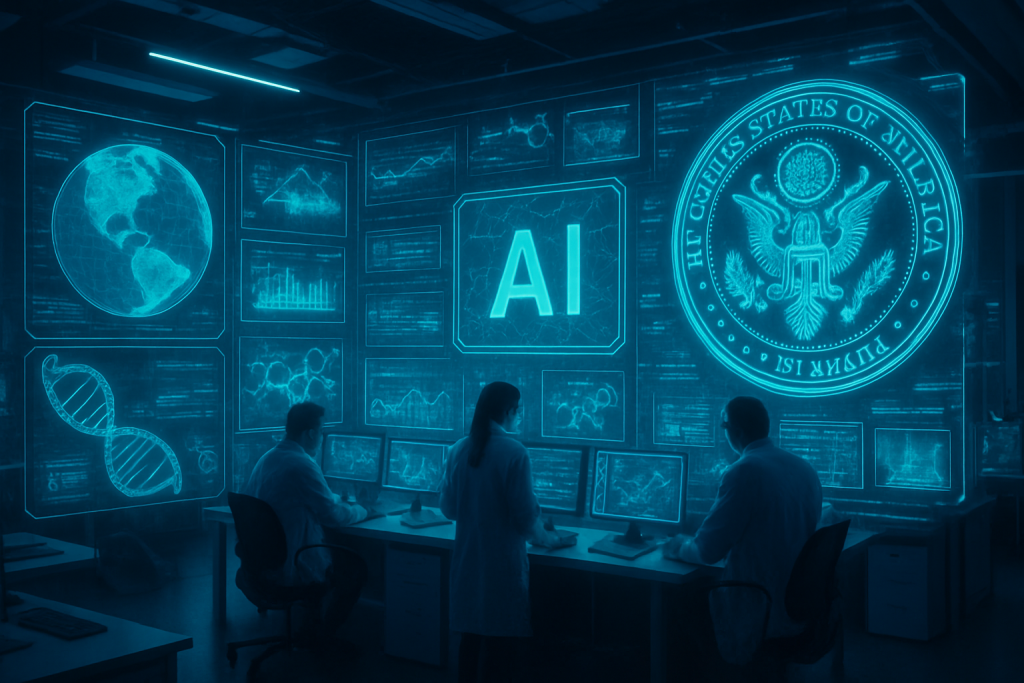

Okay, folks, buckle up. Because if you thought the AI revolution was just about chatbots and deepfakes, think again. Yesterday, November 24, 2025, President Trump dropped a bombshell: the “Genesis Mission.” And trust me, this isn’t your garden-variety government initiative. This is about supercharging science with AI, and the implications are, well, biblical.
Let’s rewind a bit. This move didn’t exactly materialize out of thin air. Back in January, Trump signed Executive Order 14179, a.k.a. “Removing Barriers to American Leadership in Artificial Intelligence.” Sounds like a mouthful, right? Basically, the administration was already laying the groundwork, clearing out any perceived bureaucratic roadblocks to AI innovation. Think of it as the government equivalent of decluttering your apartment before throwing a massive party. Now, Genesis Mission is the party itself.
So, what *is* this Genesis Mission all about? In a nutshell, it’s about taking all those juicy scientific datasets squirreled away in government vaults and unleashing AI on them. We’re talking about the kind of data that makes even the most seasoned researchers drool- massive troves of information from national labs, supercomputers, and scientific repositories. The goal? To train AI models so advanced they can practically design experiments themselves, predict outcomes, and accelerate scientific discovery at warp speed.
Think of it like this: remember in “Iron Man” when Tony Stark would just tell his AI, JARVIS, to run simulations and design new suits? That’s the vibe they’re going for, but instead of Iron Man suits, we’re talking about breakthroughs in biotechnology, nuclear energy, quantum science, and microelectronics. Ambitious? You bet.
The U.S. Department of Energy (DOE) is taking the lead on this, which makes sense. They’ve got the supercomputers, they’ve got the labs, and they’ve definitely got the data. According to Michael Kratsios, head of the White House Office of Science and Technology Policy, the aim is to “massively accelerate the rate of scientific breakthrough.” He’s talking about automating experiment design and building predictive models for things like protein folding and fusion plasma dynamics. For those of you who aren’t science nerds (yet!), protein folding is key to understanding diseases, and fusion plasma dynamics is, well, the holy grail of clean energy.
Energy Secretary Chris Wright chimed in, emphasizing the goal of attracting private AI investment towards scientific and engineering advancements. The idea is to create a virtuous cycle: government data fuels AI innovation, which in turn attracts private capital, leading to even more innovation. It’s like the government is trying to prime the pump of scientific progress with a hefty dose of AI.
The Implications: Beyond the Lab Coat
So, what does this all mean for the rest of us? Well, for starters, it could mean faster cures for diseases. Imagine AI sifting through mountains of genomic data to identify new drug targets or personalized treatment plans. It could also mean a breakthrough in clean energy, finally cracking the code to sustainable fusion power. And let’s not forget about advancements in materials science, leading to stronger, lighter, and more efficient materials for everything from airplanes to smartphones.
But the implications go far beyond just scientific breakthroughs. This is about maintaining U.S. dominance in AI and ensuring our competitive edge in a rapidly changing world. We’re talking about national, economic, and health security. In the 21st century, AI isn’t just a cool technology; it’s a strategic asset. And the Genesis Mission is a clear signal that the U.S. intends to stay ahead of the curve.
The Ethical Quandaries: Can AI Be Too Smart?
Of course, no discussion about AI is complete without addressing the ethical questions. As AI becomes more powerful and autonomous, we need to grapple with issues of bias, accountability, and control. Who decides which research questions AI should prioritize? How do we ensure that AI algorithms are fair and unbiased? And what happens when AI makes decisions that have significant consequences for human lives?
These aren’t just abstract philosophical questions. They’re real-world challenges that we need to address proactively. We need to develop ethical guidelines and regulatory frameworks that ensure AI is used responsibly and for the benefit of all. It’s a bit like the debate over genetic engineering in “Gattaca” – we have the potential to achieve incredible things, but we also need to be mindful of the potential pitfalls.
The Financial Fallout: Follow the Money
From a financial perspective, the Genesis Mission is likely to be a boon for AI companies, particularly those specializing in machine learning, data analytics, and high-performance computing. Expect to see a surge in demand for AI talent, driving up salaries and creating new job opportunities. The companies that can successfully integrate AI into their scientific research and development processes will likely gain a significant competitive advantage.
But there’s also a risk of creating a two-tiered system, where well-funded institutions with access to advanced AI tools pull ahead, leaving smaller organizations and individual researchers behind. It’s crucial to ensure that the benefits of AI are shared broadly and that everyone has the opportunity to participate in the AI revolution.
In short, the Genesis Mission is a bold and ambitious initiative with the potential to transform science and society. But it also raises important ethical and economic questions that we need to address thoughtfully and proactively. The future is here, folks. And it’s powered by AI.
Discover more from Just Buzz
Subscribe to get the latest posts sent to your email.