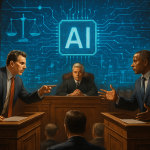
The year is 2025. Flying cars are still perpetually “five years away,” but artificial intelligence? It’s woven itself into the fabric of our lives, from composing our morning playlists to designing the next generation of smartphones. But with this increased integration comes a crucial question: who gets credit when AI helps invent something truly groundbreaking? The U.S. Patent and Trademark Office (USPTO) just dropped some knowledge, and it’s a pretty big deal.
Yesterday, November 26th, the USPTO released updated guidelines clarifying the eligibility of AI-assisted inventions for patent protection. The verdict? AI is a tool, a really, really smart tool, but still just a tool. Think of it like Tony Stark’s workshop; sure, he’s got JARVIS helping him design the Iron Man suit, but Tony’s still the one who gets to put “inventor” on the patent. In legal terms, that means only humans who conceive of the invention can be listed as inventors on patent applications.
This might seem obvious, but the path to this decision has been anything but. We’ve been heading towards this AI-invention intersection for years, and the legal system has been playing catch-up. Let’s rewind a bit.
Remember the early days of AI hype? There were whispers of machines becoming truly creative, even sentient. Some daring (or perhaps just mischievous) folks even tried to list AI systems as inventors on patent applications. This sparked a legal and ethical firestorm. Can a machine truly “invent” something, or is it just regurgitating and remixing data it’s been fed? U.S. courts have consistently sided with the former, ruling that AI systems can’t be recognized as inventors under current law. But that left a gray area: how much human contribution is enough to qualify for inventorship when AI is involved?
The USPTO’s new guidelines aim to clear up that fog. They explicitly state that only a human who meets the traditional criteria for inventorship can be named as an inventor. AI can assist, suggest, even seemingly “create” something, but the inventive spark, the “aha!” moment, must originate from a human mind. No Skynet-patented technologies anytime soon, folks.
Think of it this way: generative AI systems are now officially in the same category as laboratory equipment or research software. They’re powerful aids, but they don’t possess inventorship rights. It’s like saying a fancy electron microscope deserves credit for discovering a new virus. It’s the scientist using the microscope who gets the Nobel Prize, not the microscope manufacturer.
The USPTO also decided against creating separate standards for AI-assisted inventions. One rule to rule them all, one standard to find them. The same inventorship criteria that apply to all patents will now apply uniformly, regardless of AI involvement. This is a smart move, as it avoids creating a confusing two-tiered system that could be easily gamed.
So, what does this all mean in the real world? The implications are far-reaching. First and foremost, it provides much-needed clarity for inventors and organizations diving headfirst into AI-powered research and development. They now have a clearer understanding of the legal landscape and can structure their workflows accordingly.
Companies will need to be extra diligent in documenting the human contributions in AI-assisted inventions. This means keeping detailed records of the inventive process, highlighting the specific ways in which humans contributed to the final product. It’s like showing your work in a math problem; you can’t just write down the answer, you need to explain how you got there.
This ruling will likely affect several industries. Pharmaceutical companies using AI to discover new drugs, tech firms developing AI-powered software, and even creative fields like music and art are all impacted. Imagine a musician using AI to generate a melody. Under these guidelines, the musician, not the AI, would be considered the composer, provided they contributed meaningfully to the final composition.
From a financial perspective, this ruling reinforces the value of human ingenuity in the age of AI. It sends a message to investors that human-led innovation is still the key to success, even when AI is involved. This could lead to increased investment in human talent and training, as companies seek to develop the skills needed to effectively leverage AI in the invention process.
But let’s not pretend this is the end of the story. The debate about AI and inventorship is far from over. As AI becomes even more sophisticated, the lines between human and machine contributions will continue to blur. We may eventually need to revisit these guidelines and consider new ways of defining inventorship in the age of truly intelligent machines. For now, however, the USPTO has drawn a clear line in the sand: humans are still in charge, at least when it comes to claiming credit for inventions.
And that, my friends, is probably a good thing. After all, who wants to live in a world where robots get all the glory? We need to keep some bragging rights for ourselves, even if we’re getting a little help from our silicon-based friends.
Discover more from Just Buzz
Subscribe to get the latest posts sent to your email.