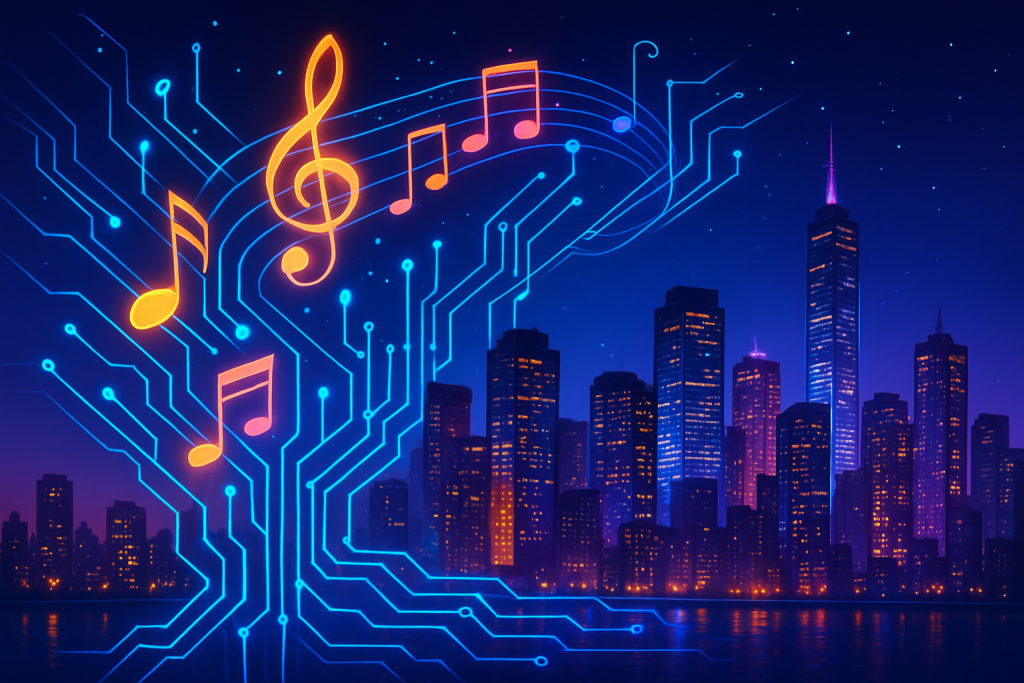

The year is 2025. Flying cars still haven’t quite taken off (pun intended), but one thing has definitely soared to new heights: the marriage of artificial intelligence and art. Specifically, music. The AI Song Contest 2025, held in the vibrant city of Amsterdam, Netherlands, has just wrapped up, and the results are in. Forget Skynet taking over the world; it seems AI is more interested in topping the charts.
This wasn’t some back-alley experiment or a niche conference for tech bros. This was the sixth annual AI Song Contest, a global stage where human artists team up with their silicon-based collaborators to craft tunes that, well, hopefully don’t sound like a dial-up modem trying to sing opera. Twenty-nine entries from across the globe battled it out, each a unique blend of human emotion and algorithmic precision. The stakes? Bragging rights, of course, and a glimpse into the future of music itself. Think Eurovision, but with more code and less questionable fashion choices (though, let’s be honest, the AI might have a thing or two to say about that too).
So, who took home the coveted Golden Algorithm award? The winners, representing Brazil, are an act calling themselves GENEALOGY, with their song “REVOLUTION.” Now, I know what you’re thinking: “Another song about revolution? Haven’t we heard it all before?” But hold on. This isn’t your typical protest anthem. This is a track forged in the fires of machine learning, tempered by human artistry, and designed to make you question everything you thought you knew about music.
But how exactly does one make an AI song? It’s not like you just type “write a banger” into a prompt and call it a day. The process behind “REVOLUTION” is fascinating. GENEALOGY employed advanced AI algorithms that essentially devoured centuries of musical history, from Bach to Beyoncé, analyzing patterns, chord progressions, lyrical themes, and even the subtle nuances of popular trends. The AI then spat out melodies, harmonies, and lyrics, a sort of Frankenstein’s monster of musical ideas. That’s where the human artists stepped in. They took this algorithmic raw material and molded it, shaped it, injected it with emotion, and imbued it with cultural context. They added the soul that the machine, for now at least, couldn’t provide. It’s like a sculptor taking a block of marble and turning it into a masterpiece; the AI provides the marble, the artist wields the chisel.
The voting process was a democratic blend of human judgment and digital metrics. A jury of music industry experts and AI specialists weighed in, accounting for 50% of the final score. The other 50% came from online public voting, meaning anyone with an internet connection could have a say in who won. This hybrid approach ensured that both artistic merit and popular appeal were considered. It’s a system that reflects the tension between the old guard and the new, between tradition and innovation.
The Implications of an AI Anthem
The victory of “REVOLUTION” is more than just a catchy tune; it’s a cultural bellwether. It signals a growing acceptance, even celebration, of AI’s role in creative industries. We’re moving beyond the fear of machines replacing artists and towards a future of collaboration, where humans and AI work together to push the boundaries of artistic expression. Think of it as the ultimate power ballad duet, only one of the singers is a supercomputer.
But this brave new world of AI-assisted music also raises some thorny questions. What about copyright? Who owns the rights to a song co-created by an AI? The artist? The programmer? The company that owns the AI? These are legal minefields that lawyers and lawmakers are only just beginning to navigate. It’s a real-world example of the Ship of Theseus paradox: if you replace every plank of a ship, is it still the same ship? If an AI generates most of a song, is it still the artist’s song?
And what about the role of the artist? Does AI diminish human creativity, or does it enhance it? Does it democratize music creation, allowing anyone to become a composer, or does it further concentrate power in the hands of those who control the technology? These are philosophical debates that will likely rage on for years to come. It’s a bit like the debate around synthesizers in the 80s; some saw them as a threat to “real” musicians, while others embraced them as a new tool for artistic expression. Now, synthesizers are a staple of modern music, and AI may well follow the same path.
From a financial perspective, the AI Song Contest and the success of “REVOLUTION” could have significant implications for the music industry. AI could streamline the songwriting process, reduce production costs, and even predict hit songs with uncanny accuracy. This could lead to a boom in new music, but it could also disrupt traditional business models and put some musicians out of work. It’s a classic example of technological disruption, where innovation creates both opportunities and challenges.
Ultimately, the AI Song Contest 2025 isn’t just about music; it’s about the future of creativity itself. It’s about how we define art, how we collaborate with technology, and how we navigate the ethical and societal implications of artificial intelligence. As GENEALOGY’s “REVOLUTION” echoes across the globe, it’s a reminder that the future is not something that happens to us; it’s something we create, together, one algorithm and one heartfelt melody at a time. Whether that future sounds like a beautiful symphony or a chaotic cacophony remains to be seen, but one thing is certain: the music industry will never be the same.
Discover more from Just Buzz
Subscribe to get the latest posts sent to your email.