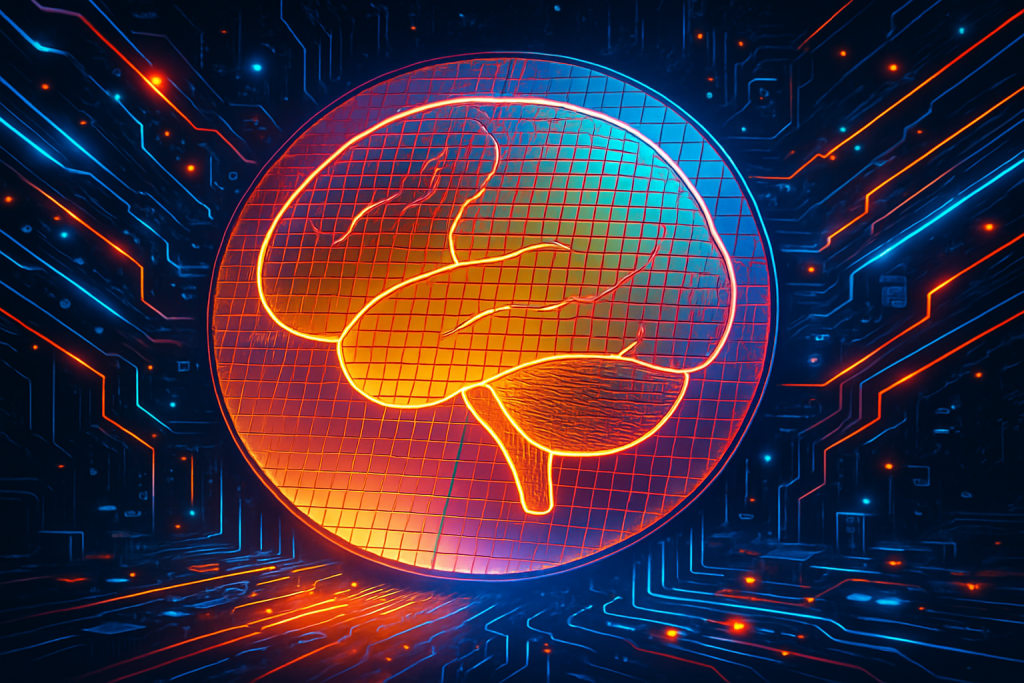

January 16th, 2026. Mark it on your calendars, folks. Not just because it’s my grandma’s 103rd birthday (still crushing Candy Crush, by the way), but because it marks a pivotal moment in the relentless march of artificial intelligence. OpenAI, the folks who brought us the GPT series and a healthy dose of existential pondering, just announced a major power-up: a strategic alliance with Cerebras Systems. And Cerebras? Well, they aren’t your grandpa’s CPU manufacturer. They’re building brains the size of dinner plates. Literally.
This isn’t just another press release; it’s a sign of the times. A neon-lit arrow pointing towards a future where AI isn’t just clever, it’s computationally unstoppable. Think Skynet, but hopefully with better PR.
But before we all start hoarding canned goods, let’s unpack this a bit. What exactly is going on, and why should you, a discerning reader of Just Buzz, care?
Think of training an AI model like teaching a dog a new trick. You show it the treat (data), give it the command (algorithm), and reward it when it gets it right (optimization). Now, imagine that dog is the size of Godzilla, the trick is quantum physics, and the treat is a petabyte of cat videos. That’s roughly the scale we’re talking about with modern AI. The sheer computational power required is astronomical, bordering on the absurd. Your trusty Nvidia GPU, bless its silicon heart, is starting to sweat.
That’s where Cerebras comes in. They’ve thrown out the traditional playbook of cramming individual chips onto a circuit board and instead etched an entire wafer of silicon into a single, colossal processor. We’re talking about something the size of a serving platter. It’s a radical approach, like replacing a team of plumbers with a single, ultra-efficient robot that can fix every pipe in the city simultaneously.
The Partnership: OpenAI Meets the Wafer
So, what does this partnership actually *mean*? OpenAI is essentially plugging Cerebras’s brain-in-a-box into their AI training pipeline. The goal? Speed, efficiency, and raw, unadulterated processing muscle. Think of it as giving GPT-7 a shot of pure, uncut computational adrenaline.
The expected benefits are threefold:
Faster Training Times: Time is money, especially in the AI arms race. Cutting training times means OpenAI can iterate faster, experiment more boldly, and ultimately, reach the holy grail of artificial general intelligence (AGI) sooner. Imagine waiting weeks to train a model, only to discover it’s fundamentally flawed. Now imagine that process taking days, or even hours. That’s the promise here.
Enhanced Model Performance: More processing power translates to more complex models. More complex models can learn more nuanced patterns, understand more subtle relationships, and ultimately, perform tasks with greater accuracy and sophistication. We’re talking about AI that can not only write poetry but actually understand the meaning of the words. (Okay, maybe not quite yet, but you get the idea.)
Improved Energy Efficiency: This might sound boring, but it’s crucial. Training these massive AI models sucks up a ridiculous amount of energy, contributing to carbon emissions and straining power grids. Cerebras’s architecture is designed to be more energy-efficient than traditional setups, aligning with OpenAI’s stated commitment to sustainable AI development. It’s like switching from a gas-guzzling Hummer to a sleek, electric sports car. Both get you from point A to point B, but one is a lot kinder to the planet.
Who Wins, Who Loses?
The immediate winners are OpenAI and Cerebras, obviously. OpenAI gets a significant competitive advantage in the AI race, and Cerebras gets validation (and a hefty payday) for its innovative technology. But the ripple effects extend far beyond these two companies.
Other AI labs, like DeepMind and Anthropic, are undoubtedly watching closely. This partnership puts pressure on them to find their own solutions to the computational bottleneck, whether that means developing their own specialized hardware or forging similar alliances with other chipmakers. Nvidia, the current king of the GPU hill, might be feeling a slight tremor in their silicon kingdom. While GPUs will remain essential for many AI tasks, Cerebras presents a viable alternative for the most demanding workloads.
And what about the rest of us? Well, faster and more efficient AI development ultimately benefits everyone. Think of better medical diagnoses, more personalized education, and smarter infrastructure management. Of course, there are also potential downsides, like increased automation and the displacement of human workers. But that’s a conversation for another time (though we’ll definitely be having it).
The Bigger Picture: AI and the Limits of Moore’s Law
This partnership highlights a fundamental challenge facing the AI industry: the slowing of Moore’s Law. For decades, the relentless march of technological progress meant that computers got faster and cheaper at an exponential rate. But that trend is starting to plateau. We’re reaching the physical limits of how small we can make transistors. This means that simply shrinking the components on a chip isn’t enough anymore. We need to find new and innovative ways to boost performance, and that’s exactly what Cerebras is doing.
It’s like trying to win a Formula 1 race. You can’t just keep adding more horsepower to the engine. You need to optimize the aerodynamics, improve the suspension, and find a driver who can push the car to its absolute limits. Similarly, in AI, we need to optimize the hardware, refine the algorithms, and find the right data to unlock the full potential of these systems.
Ethical Considerations and the Future of AI
Of course, with great power comes great responsibility. As AI becomes more capable, we need to grapple with the ethical implications. How do we ensure that these systems are used for good, and not for harm? How do we prevent bias from creeping into the algorithms? How do we protect privacy in a world increasingly dominated by AI-powered surveillance? These are not easy questions, and they require a concerted effort from researchers, policymakers, and the public at large.
The partnership between OpenAI and Cerebras is a technological leap forward, but it’s also a reminder that we need to proceed with caution. AI has the potential to transform our world in profound ways, but it’s up to us to ensure that that transformation is a positive one.
So, as we raise a glass to OpenAI and Cerebras, let’s also raise a glass to the future of AI. A future that is not just powerful, but also ethical, sustainable, and ultimately, beneficial to all of humanity. And maybe, just maybe, a future where my grandma can finally beat that Candy Crush level.
Discover more from Just Buzz
Subscribe to get the latest posts sent to your email.