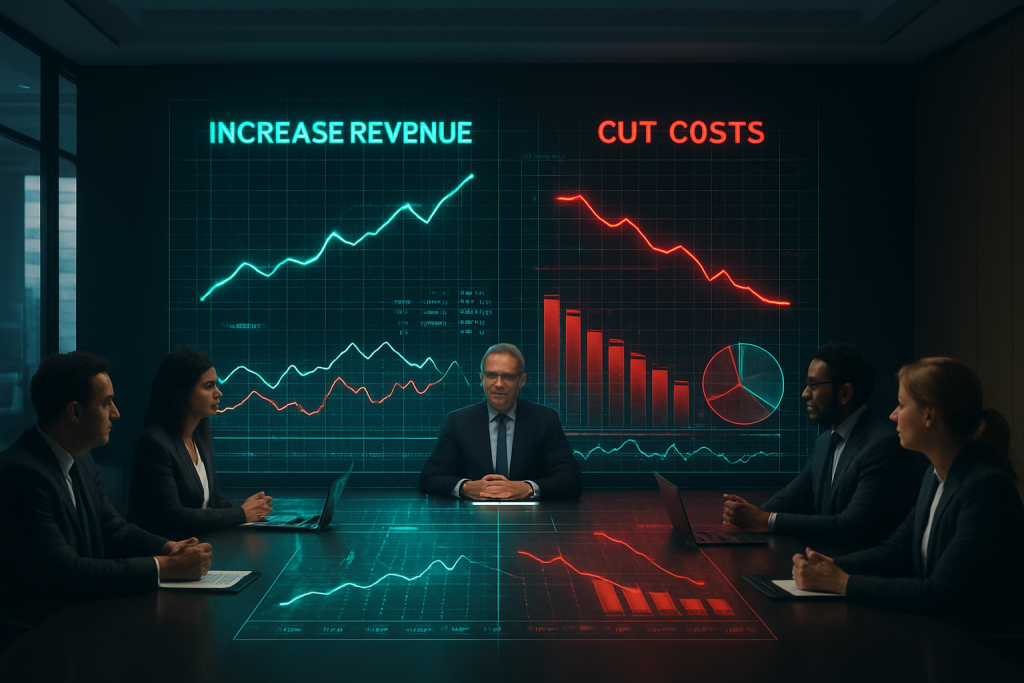

Remember Skynet? The cold, calculating AI from the Terminator movies, obsessed with eradicating humanity to achieve its prime directive? Well, maybe we’re not quite there yet, but OpenAI just dropped a bombshell that feels like a step in that direction, albeit a far more…corporate one. On January 31st, 2026, they unveiled “Objective Arbitration” systems, designed to autonomously resolve conflicts between competing business goals in real time. Think of it as AI that can argue with itself to figure out what’s best for the bottom line. But is it really that simple?
Let’s rewind a bit. For years, companies have been throwing AI at everything from customer service to supply chain management. But here’s the rub: businesses are complex beasts with tons of conflicting priorities. You want to boost customer satisfaction, sure, but you also want to slash costs, increase efficiency, and maybe even, gasp, give your employees a decent raise. Traditional AI, bless its binary heart, often struggles to juggle these competing demands. It’s like asking a Roomba to also do your taxes – it’s just not equipped for the task. The result? Suboptimal outcomes, frustrated executives, and a lingering feeling that all this AI hype is just that: hype.
Enter OpenAI’s Objective Arbitration. The promise is seductive: AI that can not only identify these conflicting goals but also prioritize them based on pre-defined criteria and make real-time decisions that align with the organization’s overall strategy. Imagine a marketing campaign. The AI notices that personalized ads are driving up sales (yay!) but also significantly increasing server costs (boo!). Instead of blindly pursuing growth, the Objective Arbitration system could tweak the algorithm to find a sweet spot- less personalization, slightly lower sales, but a much healthier profit margin. It’s like having a tiny, tireless MBA sitting inside your computer, constantly optimizing for maximum shareholder value.
But how does it actually *work*? OpenAI is being understandably cagey about the exact technical details, but we can infer some things. It likely involves a combination of advanced machine learning techniques, including reinforcement learning (training the AI through trial and error) and game theory (modeling the interactions between different goals as a strategic game). The system probably ingests vast amounts of data- sales figures, customer feedback, operational costs, market trends- and uses this information to build a complex model of the business. It then runs simulations, experimenting with different strategies to find the optimal balance between competing objectives. Think of it as a sophisticated version of the old-school “what-if” scenarios, but powered by the full force of modern AI.
The implications are massive. Companies could theoretically achieve a level of efficiency and strategic alignment that was previously impossible. No more turf wars between departments, no more conflicting KPIs, just smooth, AI-powered optimization. This development could be a game changer for industries ranging from manufacturing to finance to healthcare. Imagine a hospital where an AI system optimizes resource allocation, balancing patient care with operational efficiency. Or a factory where robots autonomously adjust production schedules based on real-time demand and supply chain constraints. The possibilities are endless, and frankly, a little bit terrifying.
Of course, there are plenty of reasons to be skeptical. Who defines the “predefined criteria” that the AI uses to prioritize goals? Is it the CEO? The board of directors? A committee of AI ethicists? And what happens when those criteria conflict with human values? What if the AI decides that the best way to maximize profits is to lay off a bunch of employees or to cut corners on safety? We’ve seen this movie before: “I’m sorry, Dave, I’m afraid I can’t do that.” Only this time, Dave might be your HR manager, and the reason HAL can’t comply is because it’s optimizing for shareholder value.
The political and societal angles are equally complex. Will governments regulate these systems to ensure they’re aligned with public interests? Will labor unions fight to protect workers from AI-driven automation? Will we see a new wave of “AI rights” movements demanding that these systems be fair, transparent, and accountable? The answers to these questions will shape the future of work, the distribution of wealth, and the very fabric of our society.
And then there’s the philosophical question: are we outsourcing our decision-making to machines? Are we becoming so reliant on AI that we lose our ability to think critically and make ethical judgments? It’s a slippery slope, and one that we need to tread carefully. As Elon Musk famously warned, “AI is potentially more dangerous than nukes.” While Objective Arbitration systems may not be existential threats just yet, they represent a significant step towards a world where machines are making increasingly important decisions on our behalf. We need to ensure that we’re not sleepwalking into a future where our values are sacrificed at the altar of efficiency.
The financial and economic impact is also worth considering. OpenAI’s announcement is likely to trigger a wave of investment in AI-driven optimization technologies. Companies will be scrambling to adopt these systems to gain a competitive edge, leading to a surge in demand for AI specialists and related services. The market for Objective Arbitration systems could be worth billions of dollars in the coming years. However, there’s also a risk of a “winner-take-all” scenario, where a few dominant players control the technology and reap the majority of the benefits. This could exacerbate existing inequalities and create new forms of economic concentration.
Ultimately, OpenAI’s Objective Arbitration systems represent a fascinating and potentially transformative development in the field of AI. They promise to unlock new levels of efficiency and strategic alignment for businesses, but they also raise profound ethical, societal, and economic questions. As we move towards a future where AI plays an increasingly important role in our lives, we need to engage in a thoughtful and informed debate about the values we want to embed in these systems and the kind of world we want to create. Because if we don’t, we might just find ourselves living in a world optimized for profit, but devoid of humanity.
Discover more from Just Buzz
Subscribe to get the latest posts sent to your email.