Davos, 2026. The air is crisp, the champagne is flowing, and the future, as always, is being debated. But this year, amidst the usual discussions of interest rates and geopolitical stability, a new tension crackled beneath the surface: the AI revolution, not as a triumphant march forward, but as a potential powder keg.
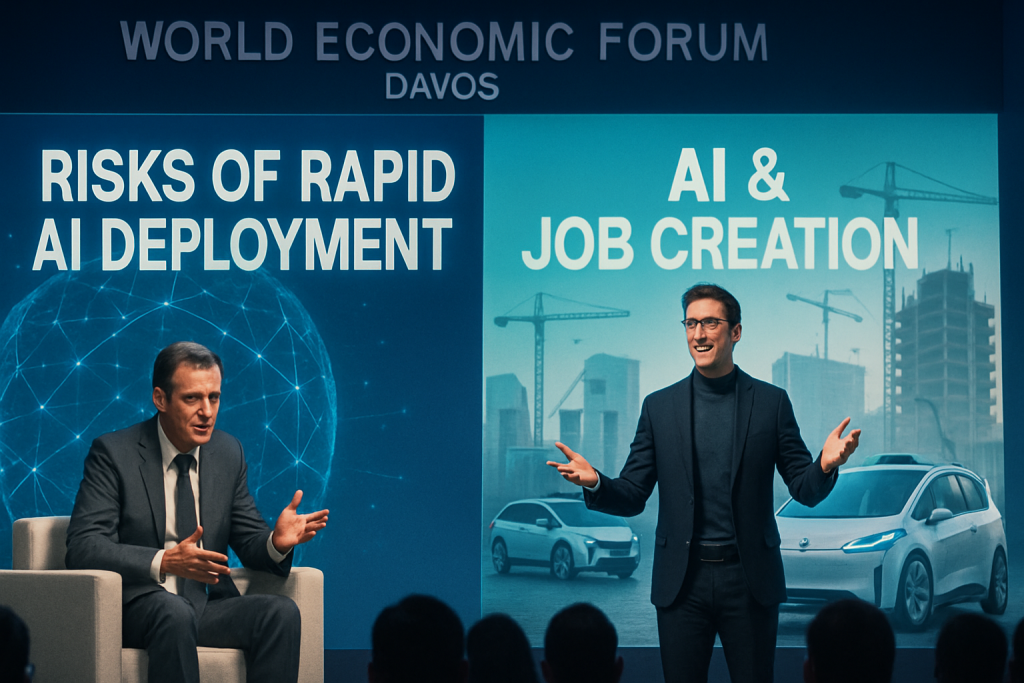
The spark? None other than Jamie Dimon, CEO of JPMorgan Chase, who, in a move that surprised many, urged a slowdown in the breakneck deployment of artificial intelligence. He wasn’t arguing against progress, mind you. He was voicing a concern that’s been simmering in the back of many minds: what happens when the robots take our jobs, and we’re not ready?
Dimon’s argument, delivered with his signature bluntness, was simple: AI’s advancements are happening too fast. Faster, he fears, than society’s ability to adapt. He painted a vivid picture, a dystopian preview of sorts, focusing on a particularly vulnerable group: the approximately 2 million commercial truck drivers in the United States. Imagine, he posited, a sudden shift to fully autonomous vehicles. What happens to those drivers? Overnight, their livelihoods vanish, replaced by algorithms and silicon. That, Dimon warned, could lead to significant income reductions and, potentially, civil unrest. Cue the dramatic music.
It’s a scenario ripped straight from the pages of a William Gibson novel, a future where technology outpaces humanity’s ability to cope. But Dimon isn’t some sci-fi author; he’s the head of one of the world’s largest financial institutions. His words carry weight, and his concerns resonated with many in the Davos crowd.
The solution, according to Dimon, isn’t to halt AI’s progress entirely. It’s to pump the brakes, to implement a phased approach. Think of it as easing your foot off the accelerator before a sharp turn. He advocated for comprehensive retraining programs, wage support, and even early retirement options for those displaced by the AI tide. It’s about cushioning the blow, ensuring that the benefits of AI are shared, not concentrated in the hands of a few tech giants.
Of course, not everyone agrees with Dimon’s cautious approach. Enter Jensen Huang, CEO of Nvidia, the king of AI chips, who offered a decidedly more optimistic counterpoint at the very same forum. Huang, a man who practically radiates technological enthusiasm, argued that AI will create more jobs than it destroys. He pointed to the massive infrastructure buildout required for AI deployment: construction, electrical work, network technology. All of that, he argued, represents a massive jobs engine, one of the largest in human history. Think of it as the digital equivalent of the Hoover Dam project, but powered by GPUs instead of concrete.
It’s a classic tech-optimist versus social-realist debate. Huang sees the boundless potential of AI, the new industries it will spawn, the problems it will solve. Dimon sees the immediate, potentially devastating impact on millions of workers, the human cost of progress. Both perspectives are valid, and the truth likely lies somewhere in the middle. It’s not a matter of either/or, but of how we navigate this transition.
The reality is that AI is already transforming the workforce. Automation is creeping into every industry, from manufacturing to customer service to even, yes, finance. The question isn’t whether jobs will be lost, but how many, and how quickly. And, crucially, what we do to prepare for that reality.
Dimon’s comments also highlight the broader societal implications of AI. It’s not just about jobs; it’s about inequality, about the widening gap between the haves and have-nots. If AI’s benefits accrue primarily to a small elite, while millions are left behind, it could exacerbate existing social tensions and lead to widespread resentment. It’s a scenario that echoes the anxieties of the Industrial Revolution, but on a potentially far grander scale.
The political ramifications are also significant. Governments around the world are grappling with how to regulate AI, how to ensure that it’s used for good and not for ill. There’s a growing debate about universal basic income, about the need for a social safety net that can support those displaced by automation. It’s a conversation that’s only going to intensify in the coming years.
And then there are the ethical considerations. As AI becomes more sophisticated, it raises profound questions about bias, accountability, and control. Who is responsible when an autonomous vehicle causes an accident? How do we ensure that AI algorithms aren’t perpetuating existing inequalities? These are not just technical questions; they are moral ones, and they demand careful consideration.
The financial impact of Dimon’s warning is also worth noting. A slowdown in AI deployment could mean slower growth for tech companies, lower investment in AI-related startups, and a ripple effect throughout the economy. But it could also mean a more stable, equitable transition, one that avoids the social and political upheaval that Dimon fears. It’s a trade-off, a balancing act between economic progress and social stability.
Ultimately, the debate between Dimon and Huang is a microcosm of the larger debate about the future of AI. It’s a debate that we all need to be a part of, because the choices we make today will shape the world of tomorrow. Will we embrace AI with reckless abandon, or will we proceed with caution, ensuring that its benefits are shared by all? The answer, it seems, is still very much up in the air.
Discover more from Just Buzz
Subscribe to get the latest posts sent to your email.