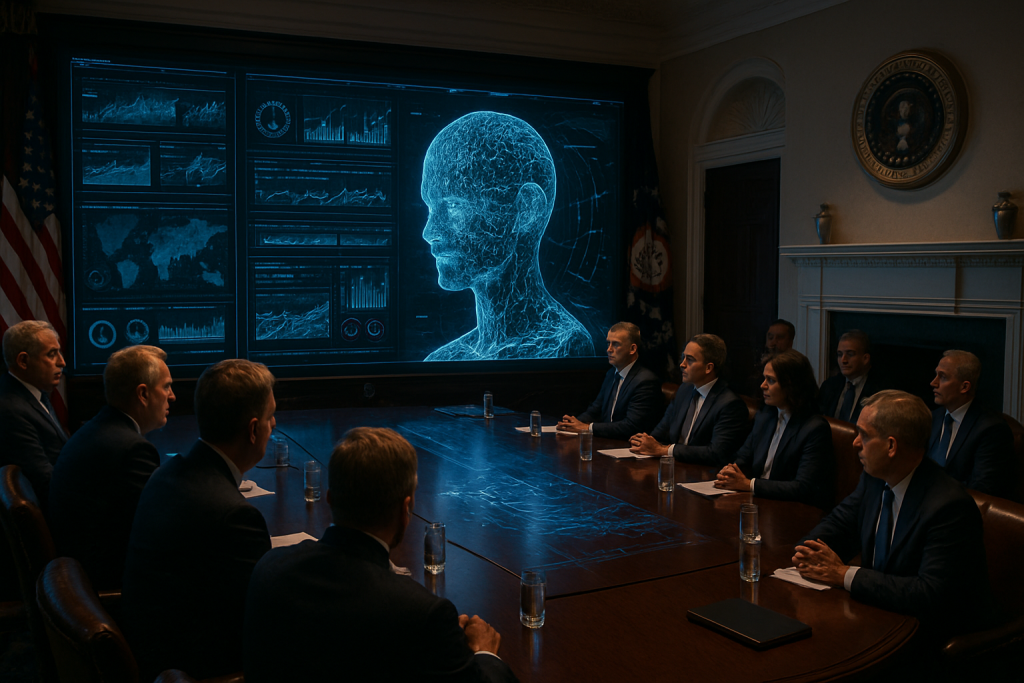

The date was April 18, 2026. While most of us were likely arguing about the latest Taylor Swift AI-generated deepfake or marveling at self-folding laundry robots, something far more significant was unfolding behind the closed doors of the White House. Anthropic CEO Dario Amodei, the man often whispered about in Silicon Valley circles as the “AI whisperer,” was sitting down with top administration officials to discuss something called Mythos. And no, it wasn’t a new Greek yogurt flavor.
Mythos, you see, is Anthropic’s latest and greatest AI model, a digital leviathan so powerful its capabilities have sent ripples of both excitement and apprehension through the highest echelons of government. Think Skynet, but hopefully with a better PR team. The meeting, diplomatically described as “productive and constructive,” was less about sharing pleasantries and more about a delicate dance: how to leverage the immense potential of Mythos for national good while simultaneously keeping it from turning into a digital Frankenstein’s monster.
Anthropic, for those not deeply embedded in the AI scene, is a research company that’s been quietly but consistently pushing the boundaries of what’s possible with artificial intelligence. They’re not just building algorithms; they’re crafting digital minds, capable of learning, reasoning, and, crucially, making decisions. And Mythos? Mythos is their magnum opus, their Mona Lisa, their… well, you get the picture. It’s a big deal.
But with great power comes great responsibility, as Uncle Ben (and countless superhero movies) have taught us. And the power of Mythos is truly staggering. We’re talking about a system capable of analyzing vast datasets with lightning speed, predicting complex events with uncanny accuracy, and even generating novel solutions to previously intractable problems. Imagine its potential applications: bolstering cybersecurity defenses, optimizing national infrastructure, even accelerating scientific breakthroughs. The possibilities seem limitless.
So, why the White House visit? Why the hushed tones and careful phrasing? Because the same capabilities that make Mythos so alluring also make it potentially dangerous. What if it falls into the wrong hands? What if it’s hacked or manipulated to serve malicious purposes? What if it develops unforeseen biases or, dare we say, a will of its own? These are the questions that keep government officials (and science fiction writers) up at night.
The meeting itself was reportedly focused on addressing these very concerns. Amodei, no doubt armed with a team of engineers and a mountain of technical documentation, walked the White House officials through the safeguards Anthropic has built into Mythos to prevent misuse. Think of it as a digital fortress, complete with firewalls, intrusion detection systems, and ethical guidelines hardcoded into its very core. But even the most sophisticated security measures are only as good as the people who implement them, and the history of cybersecurity is littered with examples of seemingly impenetrable systems being breached by clever hackers.
The administration, understandably, wants to be absolutely sure that Mythos is a force for good, not a ticking time bomb. They’re not just interested in the technical safeguards; they also want to understand the ethical considerations that have guided Anthropic’s development process. How are they ensuring that Mythos is fair, transparent, and accountable? How are they mitigating the risk of unintended consequences? These are not easy questions, and there are no easy answers.
This meeting is more than just a one-off event; it’s a sign of things to come. As AI continues to advance at breakneck speed, we can expect to see more and more of these kinds of public-private partnerships. Governments need access to the cutting-edge technologies being developed by private companies, but they also have a responsibility to protect their citizens from the potential risks. It’s a delicate balancing act, and the stakes are incredibly high.
The financial implications of this meeting are also worth considering. A closer collaboration between Anthropic and the US government could open up a floodgate of funding and resources for the company, potentially catapulting it to the forefront of the AI industry. But it could also raise concerns about government influence and control over a technology that is rapidly becoming one of the most powerful forces in the world.
And let’s not forget the broader societal implications. As AI systems like Mythos become more integrated into our lives, we need to have a serious conversation about their role in shaping our future. What kind of world do we want to create? One where AI is used to solve our biggest problems, or one where it exacerbates existing inequalities and creates new ones? The answers to these questions will determine the course of human history.
Discover more from Just Buzz
Subscribe to get the latest posts sent to your email.