It’s April 24th, 2026. The birds are singing, the sun is shining… and OpenAI just dropped a digital nuke on the AI landscape. Forget incremental improvements; we’re talking a seismic shift. They’ve unleashed GPT-5.5, and the whispers are already turning into a deafening roar. This isn’t just another model; it’s a paradigm shift, a “singularity-lite” moment that has the tech world buzzing like a caffeinated hummingbird.
Remember those old sci-fi movies where the computer could basically do everything? HAL 9000 writing code while simultaneously winning at chess and composing a symphony? Well, GPT-5.5 is edging us closer to that reality. The headline? Enhanced agentic coding, improved computer usage, accelerated knowledge work, and breakthroughs in scientific research. In short, this thing is smart. Scary smart.
Let’s rewind a bit. The journey to GPT-5.5 has been a relentless climb, a space race fueled by ambition, innovation, and a healthy dose of competitive pressure. From the initial marvel of GPT-3’s text generation to GPT-4’s multimodal capabilities, and then the refinement of GPT-5.4, each iteration has built upon the last, inching us closer to truly autonomous AI. The buzz around Anthropic’s Mythos has certainly been a catalyst, pushing OpenAI to stay ahead of the curve. It’s like the Coke vs. Pepsi battle, but with world-altering technology at stake.
So, what makes GPT-5.5 so special? The secret sauce seems to be its “agentic capabilities.” Think of it as giving the AI a set of tools and letting it loose to solve problems with minimal human intervention. It’s not just generating text; it’s orchestrating complex tasks, particularly in coding and computer operations. Imagine an AI that can not only write code but also debug it, test it, and deploy it, all without you having to lift a finger. That’s the promise of GPT-5.5.
The numbers don’t lie. GPT-5.5 is crushing benchmarks like Terminal-Bench 2.0 (82.7%) and OSWorld-Verified (78.7%). For those not fluent in geek-speak, these benchmarks measure how well an AI can perform real-world tasks in simulated environments. These scores aren’t just incremental improvements; they’re leaps and bounds ahead of the competition. It’s like comparing a horse-drawn carriage to a Formula One race car.
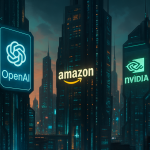
Under the hood, GPT-5.5 is powered by NVIDIA’s GB200 NVL72 infrastructure. This is the equivalent of strapping a rocket engine to a supercomputer. NVIDIA’s architecture provides the raw processing power needed to handle the immense computational demands of GPT-5.5. It’s a symbiotic relationship; OpenAI needs NVIDIA’s hardware, and NVIDIA needs OpenAI to push the boundaries of what’s possible.
The NVIDIA Employee Rave Reviews
The initial reactions have been… well, let’s just say they’re enthusiastic. Over 10,000 NVIDIA employees got early access to GPT-5.5, and the feedback has been nothing short of “mind-blowing.” These are seasoned engineers and AI experts, not easily impressed by hype. Their reactions suggest that GPT-5.5 is more than just a marginal improvement; it’s a game-changer. It’s like showing a caveman an iPhone. They simply don’t know what to make of it.
The Price of Progress
But hold on, before you start dreaming of an AI-powered utopia, there are a few catches. First, the API for GPT-5.5 isn’t publicly available yet. It’s being rolled out selectively, likely to manage demand and ensure responsible use. Second, and perhaps more significantly, it’s expensive. At $5 per million input tokens and $30 per million output tokens, GPT-5.5 costs twice as much as its predecessor. This price point will likely limit its accessibility, at least initially, to larger organizations and research institutions. It’s the equivalent of driving a Lamborghini; it’s awesome, but not everyone can afford it.

The Ripple Effects
So, what are the implications of GPT-5.5? The immediate impact will be felt in software development, research, and automation. Imagine AI-powered tools that can automate tedious coding tasks, accelerate scientific discovery, and optimize complex business processes. The possibilities are endless. We might see a surge in AI-driven startups, new breakthroughs in medical research, and a new wave of automation that transforms industries. It’s like the Industrial Revolution, but powered by algorithms instead of steam engines.
But beyond the immediate applications, GPT-5.5 raises some profound questions. As AI becomes more autonomous, what’s the role of humans? Will we become mere supervisors of intelligent machines? What are the ethical implications of delegating complex decisions to AI? These are not just theoretical concerns; they’re real questions that we need to grapple with as AI technology continues to advance. It’s like the classic dilemma posed in “The Matrix”: do we choose the blue pill and remain blissfully ignorant, or do we take the red pill and face the uncomfortable truth?

The Economic Impact
The financial implications are enormous. OpenAI’s valuation is likely to skyrocket, further solidifying its position as a leader in the AI space. NVIDIA will continue to reap the benefits of its hardware dominance. But the real winners will be the companies that can effectively leverage GPT-5.5 to create new products and services. We could see a surge in productivity, new job creation, and a significant boost to the global economy. But there’s also the risk of job displacement, increased inequality, and the concentration of power in the hands of a few tech giants. It’s a double-edged sword, a high-stakes game with potentially transformative consequences.

Ultimately, GPT-5.5 is more than just a new AI model; it’s a signpost on the road to a future where AI plays an increasingly central role in our lives. Whether that future is a utopia or a dystopia remains to be seen. But one thing is clear: the AI revolution is here, and it’s accelerating faster than ever before. Buckle up, because the ride is going to be wild.
Discover more from Just Buzz
Subscribe to get the latest posts sent to your email.